
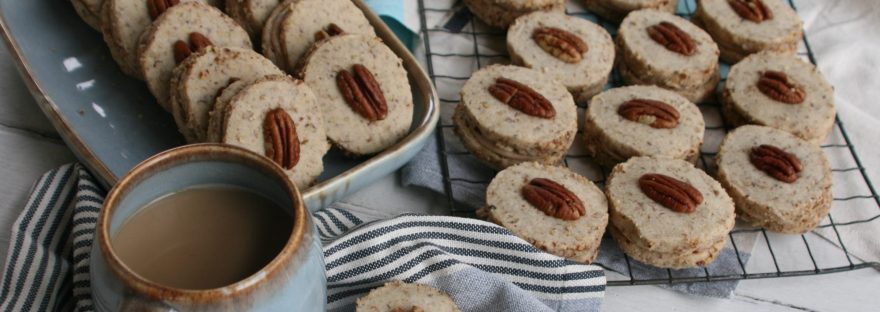
Tasked with making 24 sandwich cookies for this signature bake, I drew inspiration from Liam’s pecan and malt shortbread cookies with coffee buttercream filling that he made for this episode of The Great British Baking Show. I love pecan shortbread, which always reminds me of Pecan Sandies, a packaged cookie made in the U.S. by the Keebler Company. I decided to make a similar cookie, but I wanted a filling that would spice things up a bit. And what better filling for a cookie, I thought, than cookie butter?

Cookie butter is usually made with speculoos cookies, a traditional spiced cookie commonly found in Belgium and Holland. Cookie butter’s origin story is an example of necessity being the mother of invention. As told by a Dutch blogger known as Oma Wapsie, the story of cookie butter began after World War II, when times were tough and sweets were hard to come by in the Netherlands. In order to make the traditional Christmas koekjestaart (cookie cake), which is normally made by layering cookies with coffee buttercream, her mother would layer the cookies with a mixture of crushed speculaas (the Dutch version of speculoos) and butter (thus, cookie butter).
Apparently, in Belgium and the Netherlands where speculoos/speculaas cookies are ubiquitous, people put them in sandwiches and even spread them on toast after dunking the cookies in coffee to soften them up. One enterprising Dutch mom, Els Scheppers, wondered why no one had ever thought of making a spreadable version commercially, so in 2008 she entered the idea in a reality show called “De Bedenkers,” or “The Inventors.” Her idea didn’t take first place, but it caught the attention of the Lotus company, makers of the Biscoff cookie, one of the most well-known brands of speculoos. They approached her about helping them develop her idea and in 2009 brought their Biscoff Spread to market.
Because of a patent dispute, however, they were unable to keep other manufacturers from making it, and soon Trader Joe’s had its own version of Speculoos Cookie Spread, which by 2014 became its most popular product.
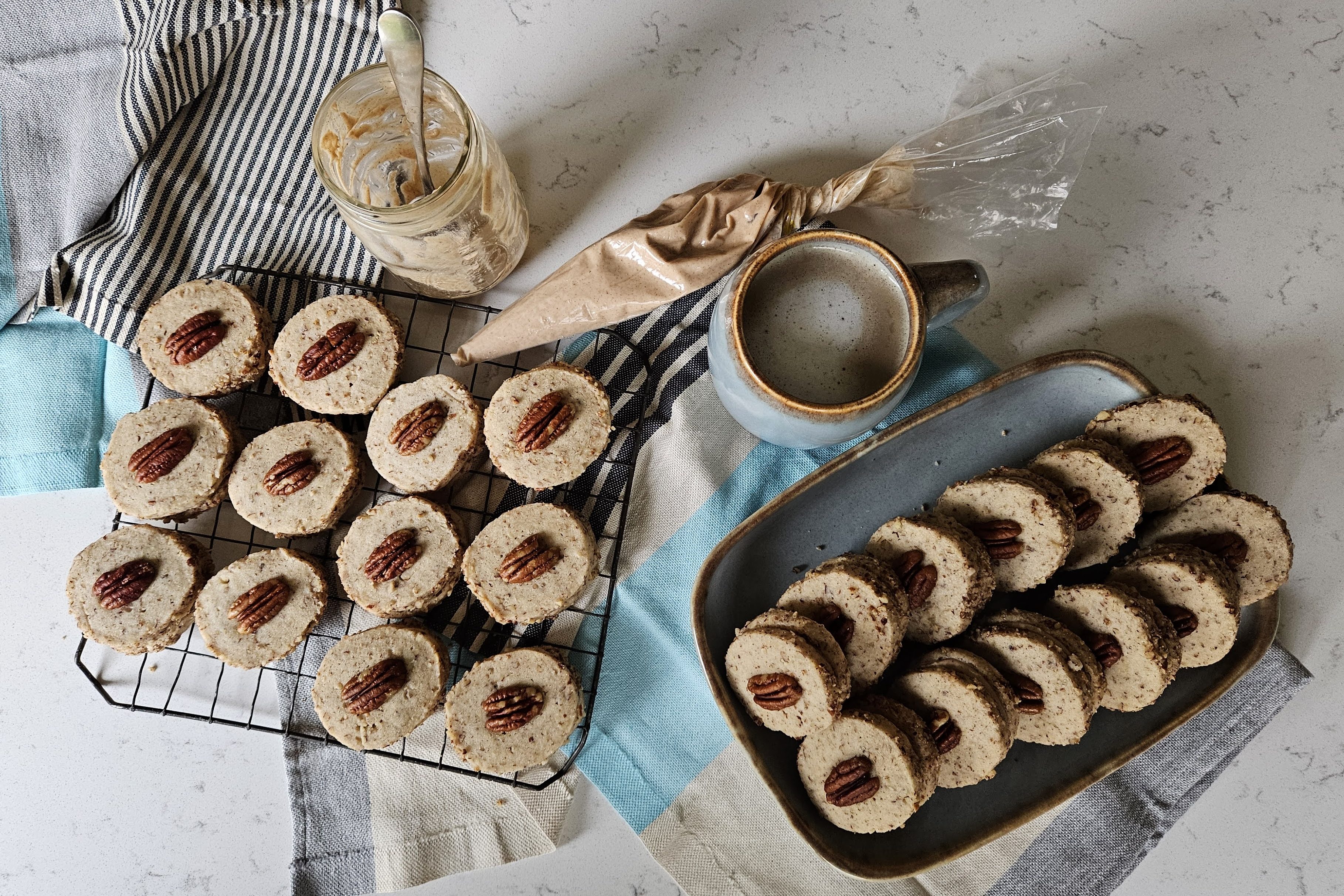
Cookie butter is used in much the same way that peanut butter or Nutella would be. People spread it on toast, pancakes or waffles. They eat it on apples, ice cream or oatmeal. It can be used as a dip for churros, graham crackers or Oreos. And, of course, it can be eaten straight from the jar with a spoon.
So why not, I thought, use it as a filling for my sandwich cookies?
But of course, to live up to Paul and Prue’s standards, I would need to make it from scratch. And to make cookie butter from scratch, I’d first have to make the speculoos/speculaas cookies from scratch. For this, I turned to the cookies I made for my iced biscuits last season.
Once my speculaas were baked and cooled, I broke them up and put them in a food processor to grind them into crumbs. Then I combined the crumbs in a saucepan with water, golden syrup (You can substitute honey, but I thought golden syrup would lend a more buttery, caramelly flavor.) and a little more cinnamon and cooked the mixture over medium heat until the crumbs had completely dissolved and the mixture felt smooth.


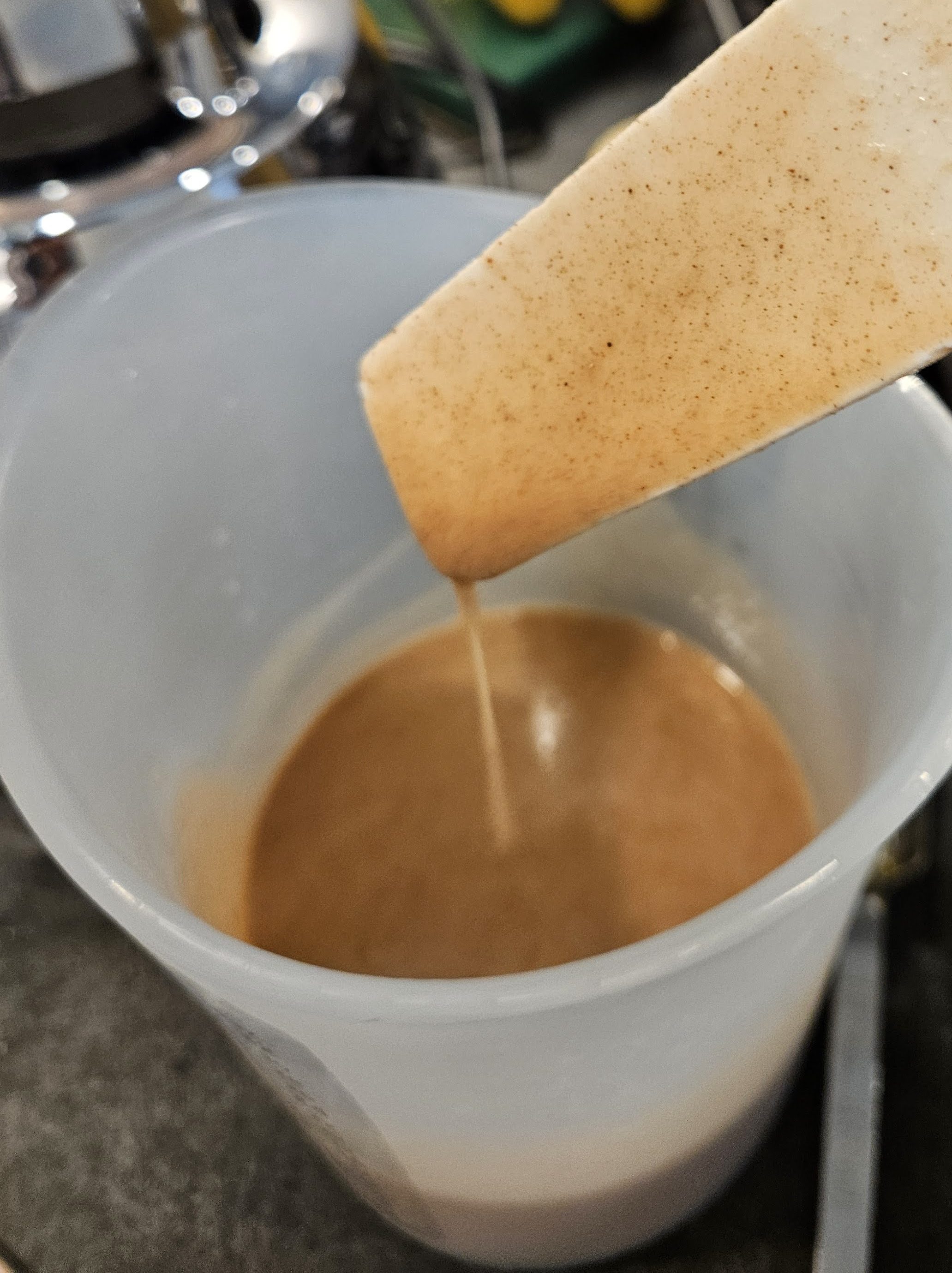
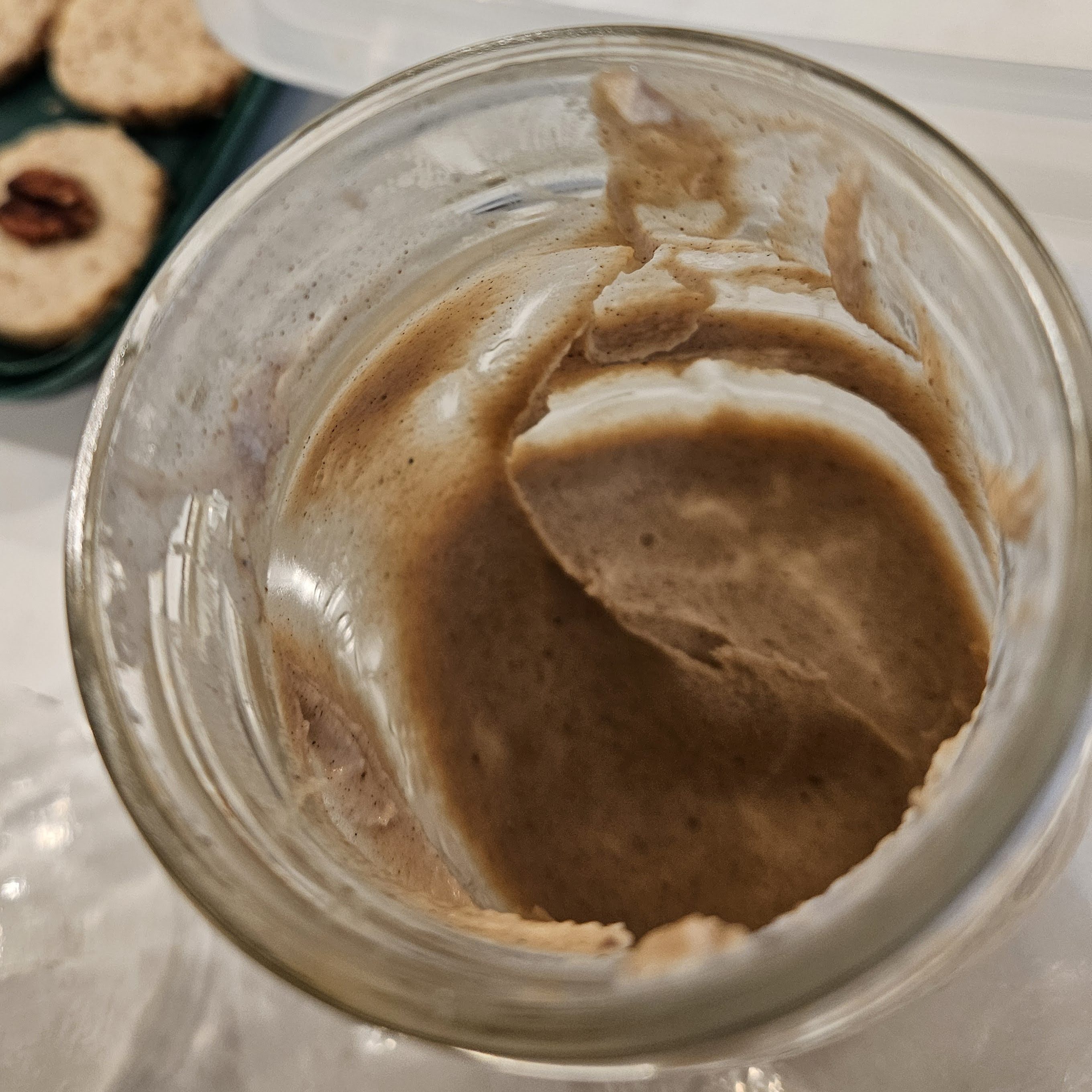
Off the heat, I poured the mixture into a tall, narrow container and, after letting it cool for a few minutes, added coconut oil and processed it with an immersion blender until completely blended and smooth. Coconut oil will result in a thicker consistency at room temperature, but if you want a softer set, you can use butter instead. Either way, it’s best to let the cookie butter firm up in the fridge for a few hours, then bring it to room temperature before using.

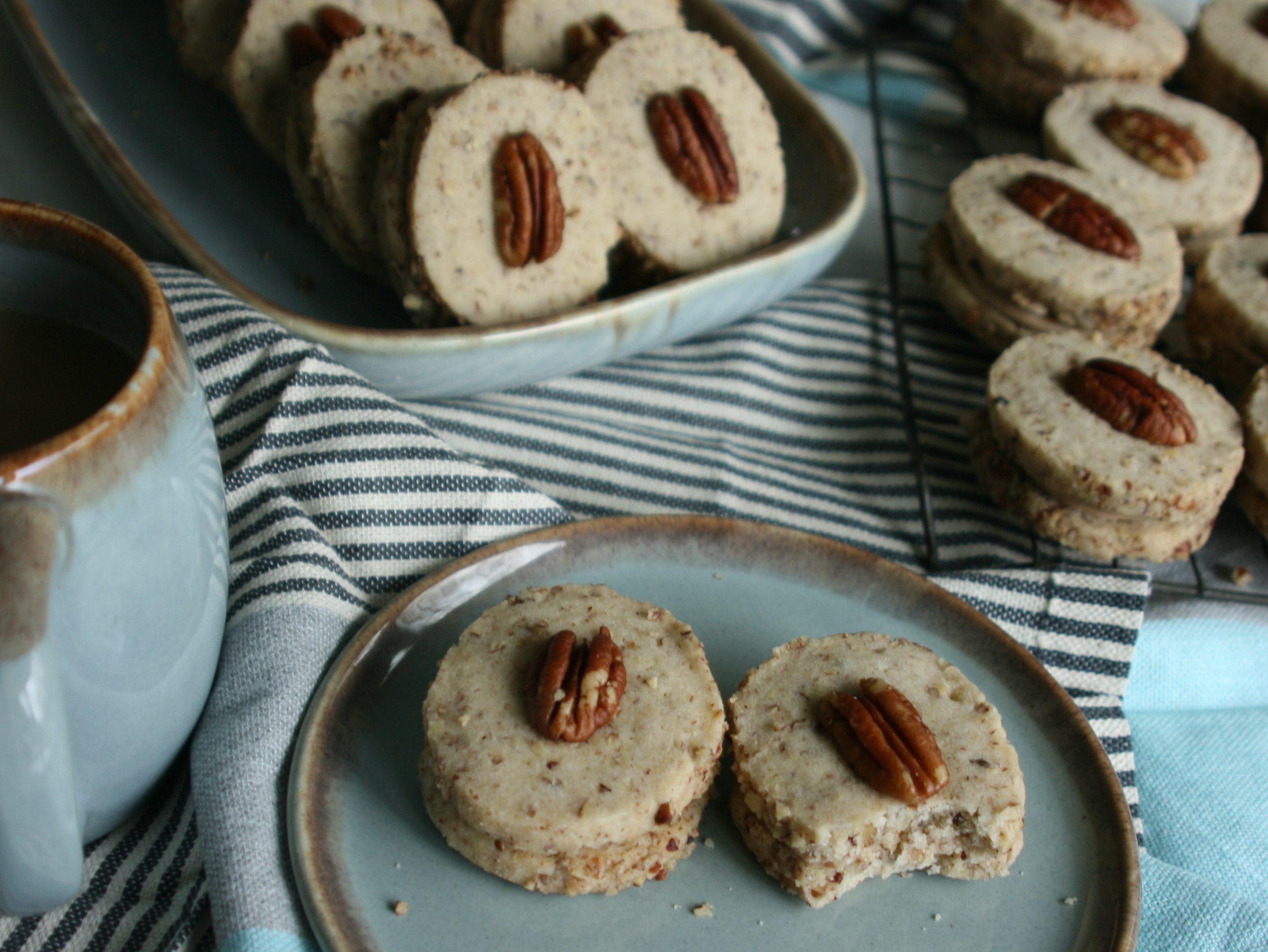
For the pecan shortbread, I used this recipe, but instead of scooping and dropping the dough by teaspoonfuls, I rolled the dough into two logs and chilled them thoroughly before slicing and baking them, resulting in more uniformly round cookies.
These cookies are really short and buttery. My only mistake was cutting them too thick, so the ratio of cookie to filling was disproportionate. The other change I’d make next time would be to increase the spice level in the cookie butter so the warmth of the spices really comes through. So in the recipe below, I’ve increased the amount of cinnamon added to the cookie butter from ¼ teaspoon to ½ teaspoon, but feel free to add more to your taste.
Even though mine turned out more Cookie Monster–sized than finger sandwich–sized, these sandwich cookies really hit the spot when you’re feeling peckish, especially accompanied by a cup of coffee or tea. So after making them, pull up a chair, pour yourself a cup of your favorite hot beverage, and enjoy!


Pecan-Shortbread Sandwich Cookies with Cookie Butter Filling
Credit for speculaas cookies: BiggerBolderBaking.com
Cookie butter recipe adapted from SeriousEats.com
For the cookie butter:
- 1 c. unsalted butter, room temp.
- ½ c. granulated sugar
- ¼ c. dark brown sugar
- 2 c. all-purpose flour
- 2½ t. ground cinnamon, divided (plus more to taste)
- ¼ t. ground nutmeg
- ¼ t. ground ginger
- ¼ t. ground allspice
- ¼ t. ground cloves
- ¼ t. baking powder
- ¼ t. baking soda
- ½ t. salt
- 1 t. vanilla extract
- 1 c. boiling water
- 2 T. golden syrup (or honey)
- 1 pinch kosher salt
- ¼ c. refined coconut oil (or unsalted butter, cubed)
For the shortbread cookies:
- 2½ c. chopped pecans, divided
- 2 c. unsalted butter, softened
- 1 c. powdered sugar
- 2 T. water
- 2 t. vanilla extract
- 4 c. all-purpose flour
- 1 t. salt
- 24 whole pecans
Directions
- First, make the speculaas cookies: In the bowl of a stand mixer fitted with a paddle attachment, cream together the butter, sugar and brown sugar on medium speed until light and fluffy, about 3 minutes. Meanwhile, in a separate bowl, mix together flour, 2 teaspoons cinnamon, other spices, baking powder, baking soda and salt.
- Add vanilla extract to butter and sugar mixture and mix until incorporated. Turn mixer to low and gradually add the flour mixture into the butter mixture, mixing until well-combined, scraping sides of bowl as needed. The dough may be dry and crumbly.
- Turn dough out onto a clean work surface and form into a ball. Divide the ball into two equal halves and then form each half into a rectangle about 2 inches wide by 1 inch thick. Wrap both in plastic wrap or parchment paper and chill for at least an hour.
- While that dough is chilling, start the shortbread cookies: Toast chopped pecans in a skillet over medium heat, stirring constantly, until fragrant. Transfer to a heat-proof plate to cool completely.
- In the bowl of a stand mixer fitted with a paddle attachment (You can use the same bowl and paddle you used for the speculaas cookies if you wipe them off with a paper towel first.), cream butter and sugar together until light and fluffy. Mix in water and vanilla.
- Once pecans are cool, place them in a food processor and process until finely chopped. Set aside 6 tablespoons of the chopped nuts for later. Combine the remaining chopped pecans with the flour and salt in a large, clean bowl.
- With mixer on low, gradually add flour mixture to butter mixture, mixing until well-combined.
- Turn dough out onto a clean work surface and form into a ball. Divide the ball into two equal halves and form each half into a 2-inch-thick log. Sprinkle reserved chopped pecans onto the work surface and roll the dough logs in the nuts, pressing down to help the nuts stick to the surface. Wrap both logs in plastic wrap or parchment paper and refrigerate for 4 hours (or freeze for about 1 hour).
- While the shortbread dough is chilling, preheat oven to 350°F (325°F convection) and remove speculaas dough from fridge. Slice each rectangle into ¼-inch slices and place on parchment-lined baking sheets. Bake for 16-18 minutes until golden brown and firm to the touch. Remove from oven and leave cookies on the baking sheets for 5 minutes before transferring to a wire rack to cool completely.
- When cooled, weigh out 8 ounces of the cookies and place in a food processor, breaking them into smaller pieces to fit, if needed. (Reserve the rest of the cookies for another use — like eating!) Pulse a few times, then process on high until the cookies are fine crumbs.
- Combine crumbs, water, ½ teaspoon cinnamon and golden syrup in a medium saucepan. Cook over medium heat, whisking constantly, until crumbs have dissolved and mixture feels smooth between your fingertips, about 90 seconds. Remove from heat and transfer to a tall, narrow container, stirring occasionally until the steam subsides, about 5 minutes.
- Add solid coconut oil to the crumb mixture and process with an immersion blender until homogeneous and smooth. Taste and add more cinnamon, if desired; then transfer mixture to a glass jar, seal to prevent moisture loss, and refrigerate to resolidify the coconut oil, about 2 hours.
- When shortbread dough feels firm to the touch, remove from fridge (or freezer) and slice into 1/8-1/4-inch slices. (Keep them as thin and uniform as possible.) Place slices on ungreased baking sheets. Choose 24 of the best-looking slices and press a pecan half into the center of each.
- Bake in preheated 350°F oven for 10-12 minutes, until just starting to brown and looking dry on top. Remove from oven and leave to cool on baking sheets for about 5 minutes, then transfer to a wire rack to cool completely.
- When shortbread cookies are cooled and cookie butter is firm but pipeable, transfer cookie butter to a piping bag fitted with a plan round tip. Pair up 24 plain shortbread cookies with the 24 pecan-topped cookies, matching size and shape as closely as possible. Turn base cookies upside down and pipe the cookie butter onto each, piping in a spiral starting in the center and stopping about 1/8 inch from the outer edge. Top each of those cookies with its matched pecan-topped cookie.
- Serve immediately. Cookies will keep in an airtight container at room temperature for several days but will become softer with time.
Up Next: Fortune Cookies
Discover more from Here's the Dish
Subscribe to get the latest posts sent to your email.
