
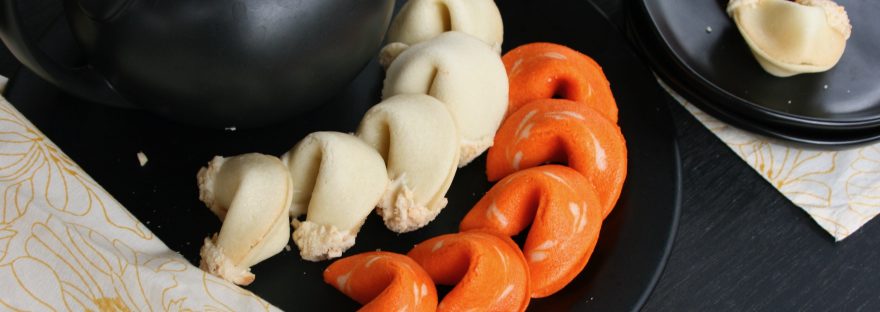
Fortune cookies, though a popular item in Chinese restaurants all over America (but not in China), actually have their origins in Japan. Their association with Chinese cuisine may be attributed, at least in part, to the fact that many Japanese Americans lost their businesses and often their homes when they were incarcerated in internment camps during World War II.
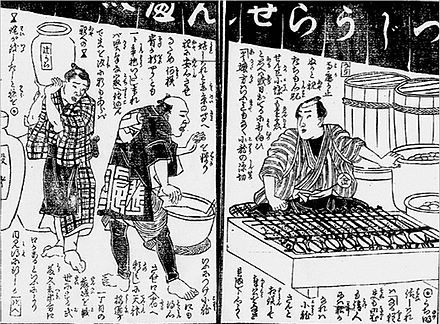
With a long, rich culture of fortune-telling, the Japanese still practice customs like getting a fortune (omikuji) printed on a long piece of paper at a temple or shrine and then tying it to a sacred tree on the way out, or consulting a rokuyo calendar, which predicts lucky and unlucky days, before planning a wedding or funeral. So it makes sense that cookies containing written fortunes have been around there since at least the mid-1800s. They are mentioned in a novel by Tamenaga Shunsui, who lived from 1790 to 1844, called The Young Grass of Spring, and depicted in a woodblock print from 1878 (see above).
These cookies, or tsujiura senbei, are also described in a book, Japan Day By Day, Vol. II, written in 1883 by an American zoologist named Edward Morse. He describes them as being brittle, made of molasses, “pinched up in a triangular form,” and tasting “like a gingersnap without the ginger.” Inside his cookie, he wrote, was the maxim, “Determination will go through rocks, why then can we not be united?” Seems like a fortune we could use in modern times! Tsujiura senbei are still made today in Kyoto, Japan, although they are more savory, flavored with miso and sesame, than the sweet variety we’re familiar with in the West.
So how did the fortune cookie cross the Pacific, and how did it become associated with Chinese cuisine?
The first person known to offer them commercially in the United States was Makoto Hagiwara, who operated the Japanese Tea Garden in San Francisco’s Golden Gate Park from 1895 to 1925. He served them to his customers with their tea. The cookies soon became so popular that he contracted a local confectionery, Benkyodo Company, to make them for him. That could be how our fortune cookies came to have a sweeter profile than the traditional tsujiura senbei. Hagiwara’s family continued to sell tea and fortune cookies at the Japanese Tea Garden until the family was removed in 1942 and interred for the duration of World War II.
There is a charming pre-war story about a group of Japanese women having lunch at a Chinese restaurant in San Francisco’s Chinatown when, after the meal, one of the women passed around some fortune cookies she brought with her. As they were laughing and giggling over the fortunes contained in the cookies, a Chinese businessman approached them to ask what they were laughing over, so they showed him the fortune cookies. A few weeks later, one of the women reported seeing that same man leaving a confectionery in Japantown with a large tin of fortune cookies, and after that, when they would go to that sweets shop to buy fortune cookies, they were often told there were none left because the Chinese were buying them all!
Whether or not that anecdote is true, these folded cookies soon began appearing in Chinese restaurants around San Francisco and then spread to Los Angeles. When World War II broke out, Japanese Americans were forced to close or sell their businesses, so Chinese restaurateurs either had to find new suppliers or figure out how to make their own fortune cookies. Because of suspicions surrounding anything related to Japan at the time, fortune cookies became known as a Chinese custom.
As American GIs passed through California on their return from the war in the Pacific, many encountered the little folded cookies at Chinese restaurants on the West Coast. When they got back home, they would ask for fortune cookies in their local Chinese restaurants. Thus, the cookies rapidly spread across the U.S.
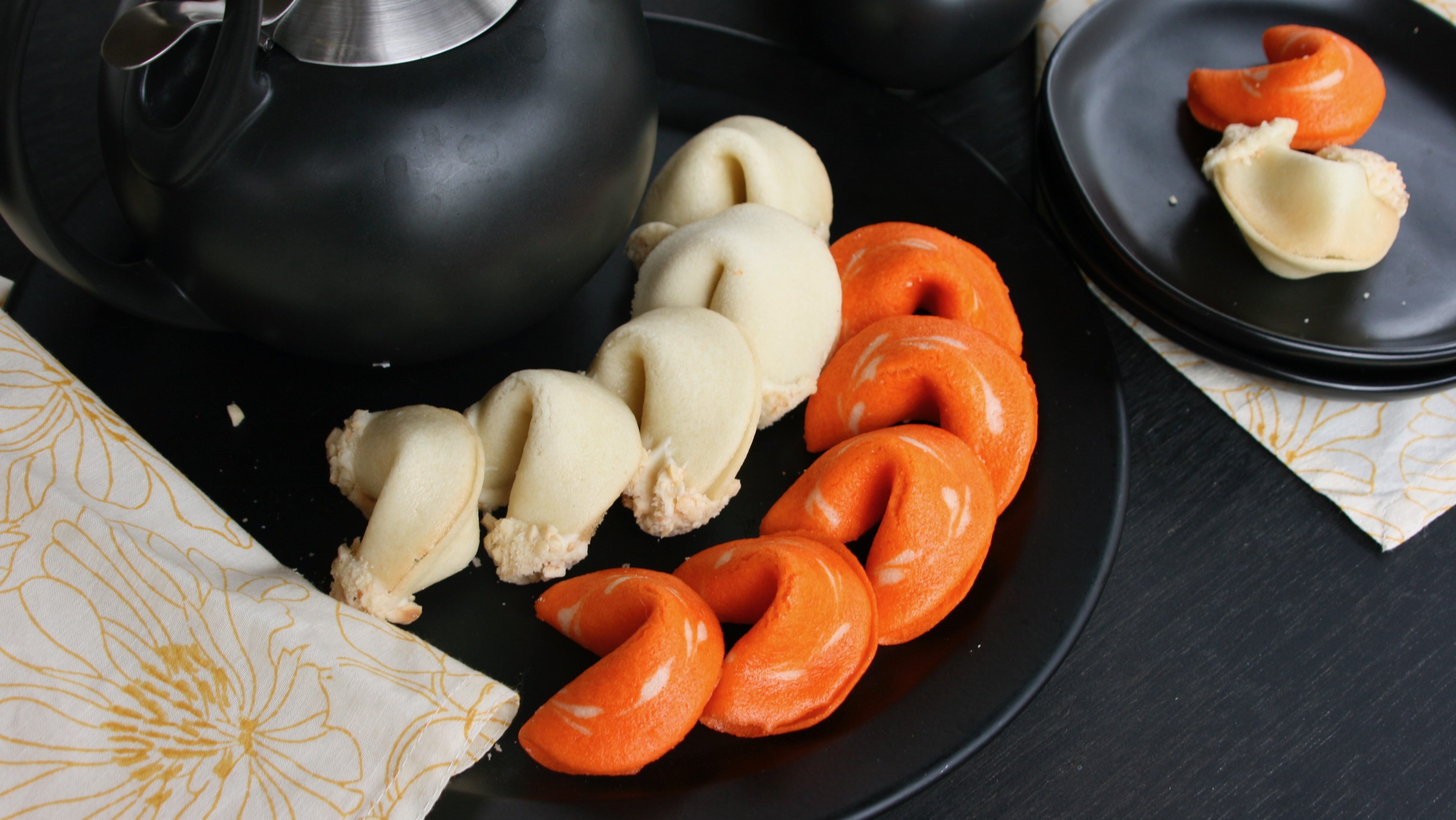
How are they made?
Fortune cookies are made with a batter of egg whites, oil (sometimes melted butter), flour and sugar. Paul Hollywood’s recipe also uses a bit of cornstarch and a pinch of salt. They are often flavored with vanilla or almond extract. For this recipe, used in the technical challenge during Biscuit Week on The Great British Bake Off, Paul specified that the batter be divided in two, half to be flavored with almond and the other half with orange extract.
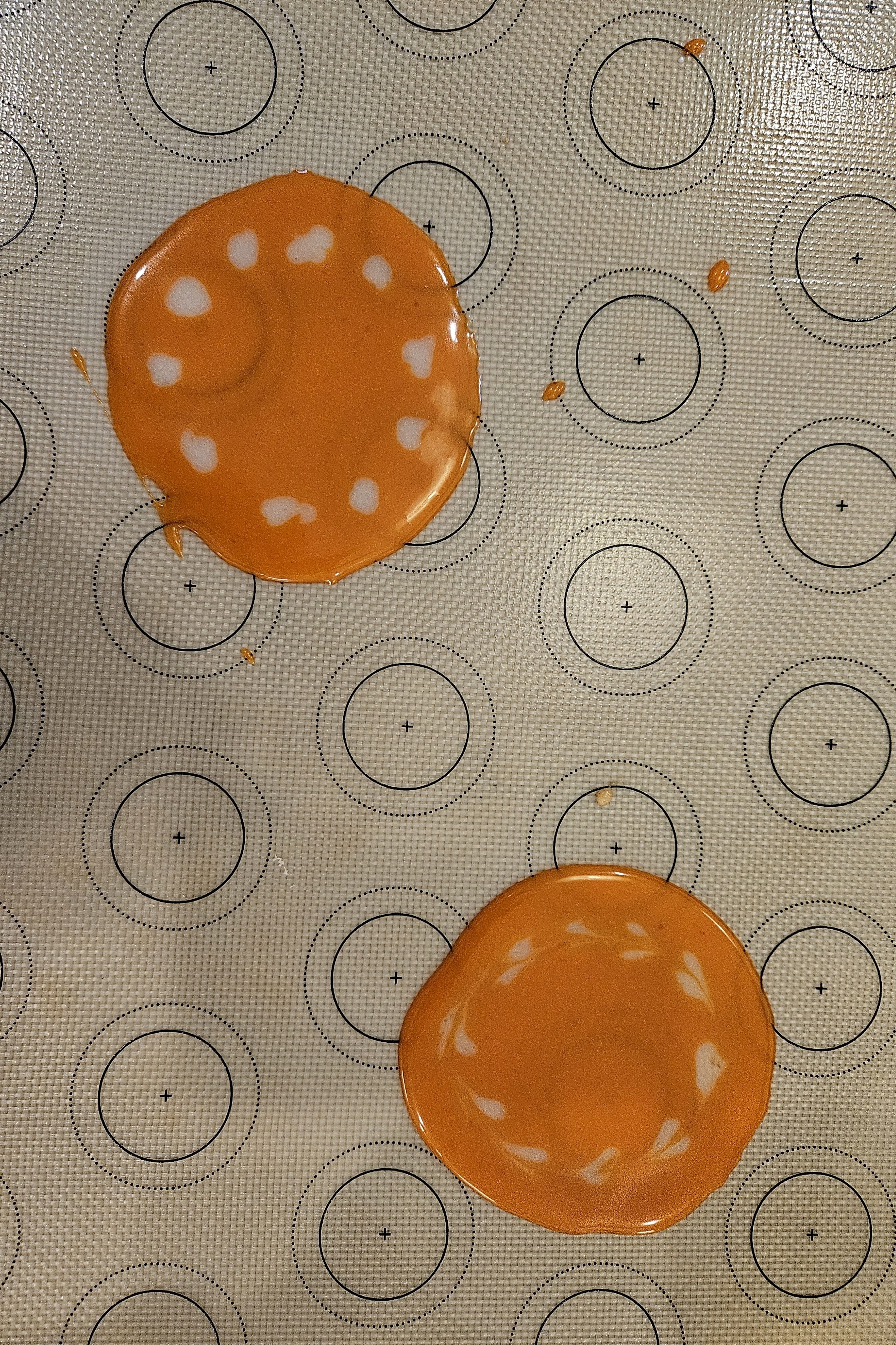
The key to getting a crisp cookie is to spread the batter very thin. I misread the recipe where it says to “place 2 tablespoons of the almond batter on the silicone mat, spaced well apart.” I thought it meant to use 2 tablespoons of batter per cookie, but I soon realized I would run out of batter before making six cookies, so I reduced it to 1 tablespoon, just as Paul intended. As a result, the first ones I made were much thicker than the last!
Because the cookies must be folded right after they come out of the oven, while they’re still hot, you can only bake about two cookies at a time. You need to drop a tablespoon of batter onto a silicone-lined baking sheet and spread it into a 3- or 4-inch circle. After making two such circles, you then bake them in a moderate (300°F) oven for 10-12 minutes.
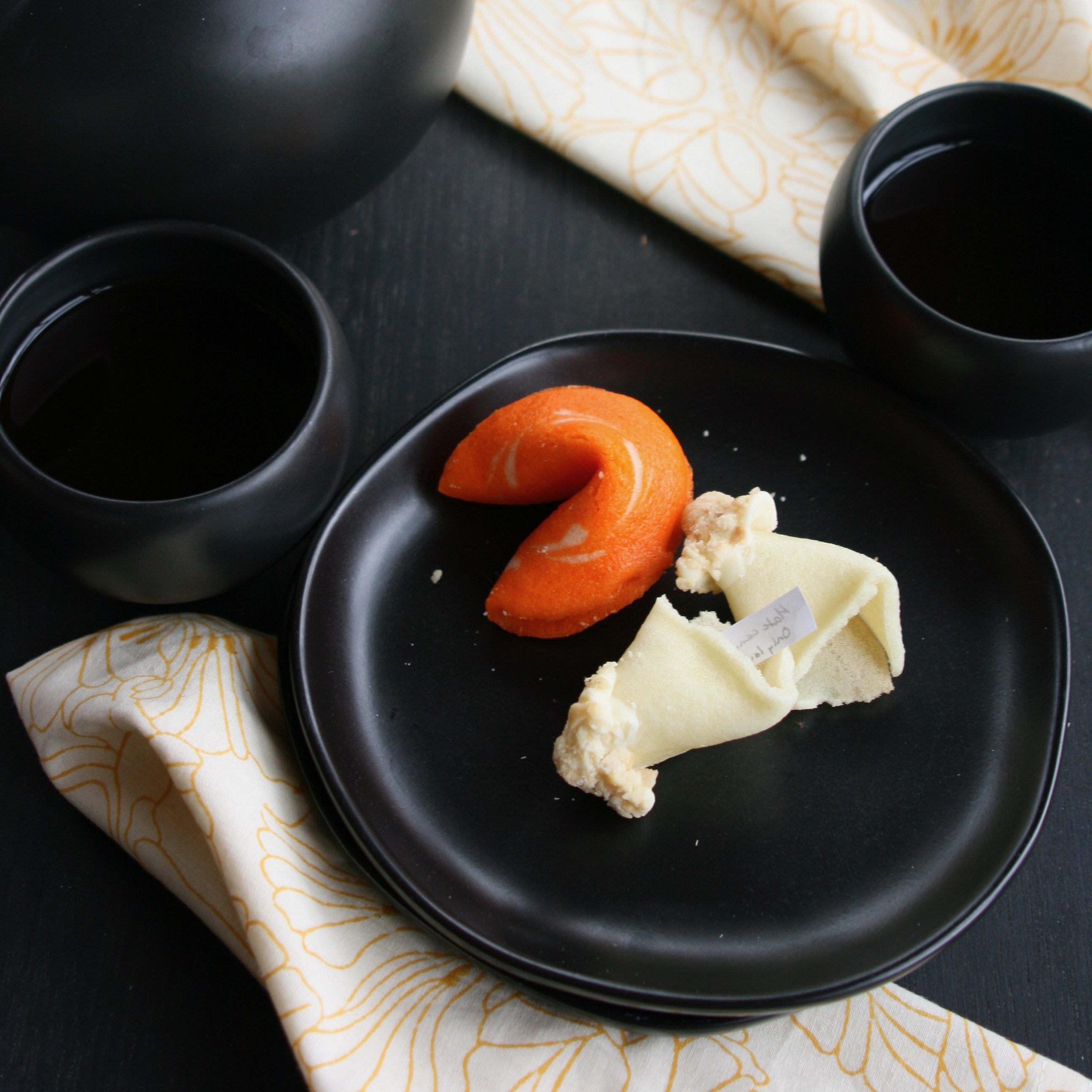
Once they are slightly brown around the edges, remove them from the oven, carefully lift each cookie from the silicone with a metal spatula, flip it over (so the bottom will be on the inside) and place your prewritten “fortune” in the center. Then fold the cookie in half, pressing the edges together with your fingers, trying not to get burned in the process! Place the fold of the cookie over the rim of a drinking glass and press down on both corners, one inside the glass and one outside, to create the classic fortune cookie shape. Put the folded cookie into a muffin tin so it maintains its shape while it cools, becoming hard and crisp in the process.
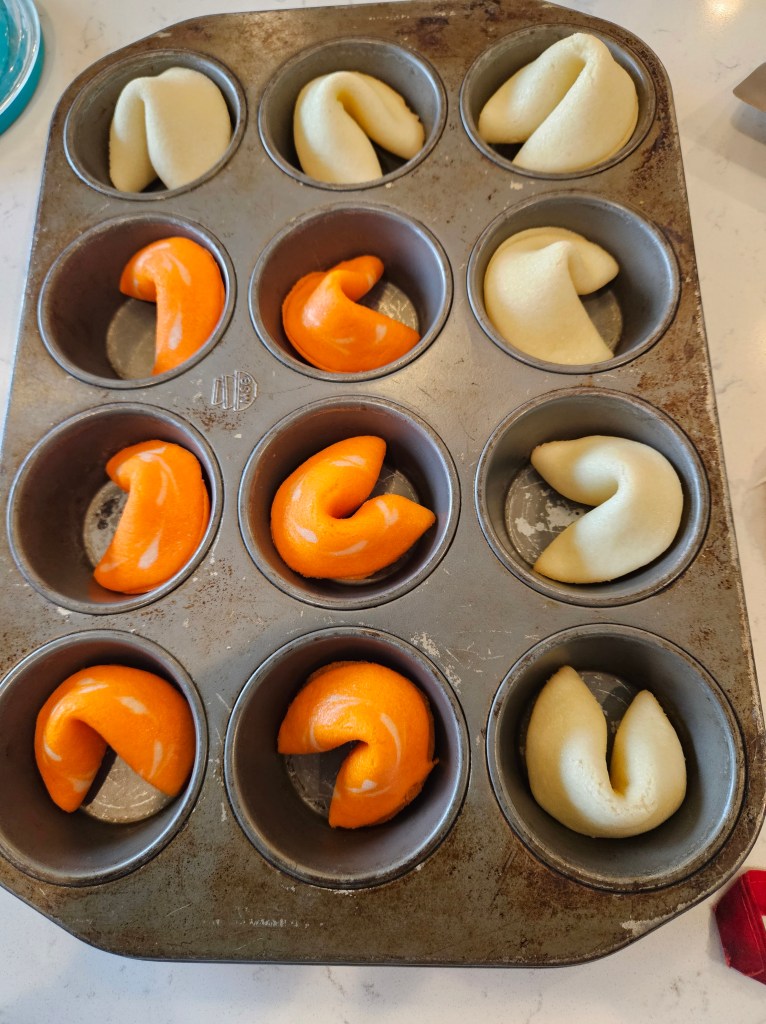
Since I used too much batter for the first couple of cookies I made, they didn’t crisp up enough, which means they wouldn’t make that satisfactory snap when broken. After doing some research, I found another recipe for fortune cookies that advised, after folding them, placing them back in a warm (200°F) oven, still in the muffin tin, then turning the oven off and leaving them for an hour (or even longer). I left some of my biggest cookies in the oven until it cooled down completely, then transferred them directly to an airtight container. It worked! They came out crisp and snappy, even after they were dipped in chocolate and hazelnuts!
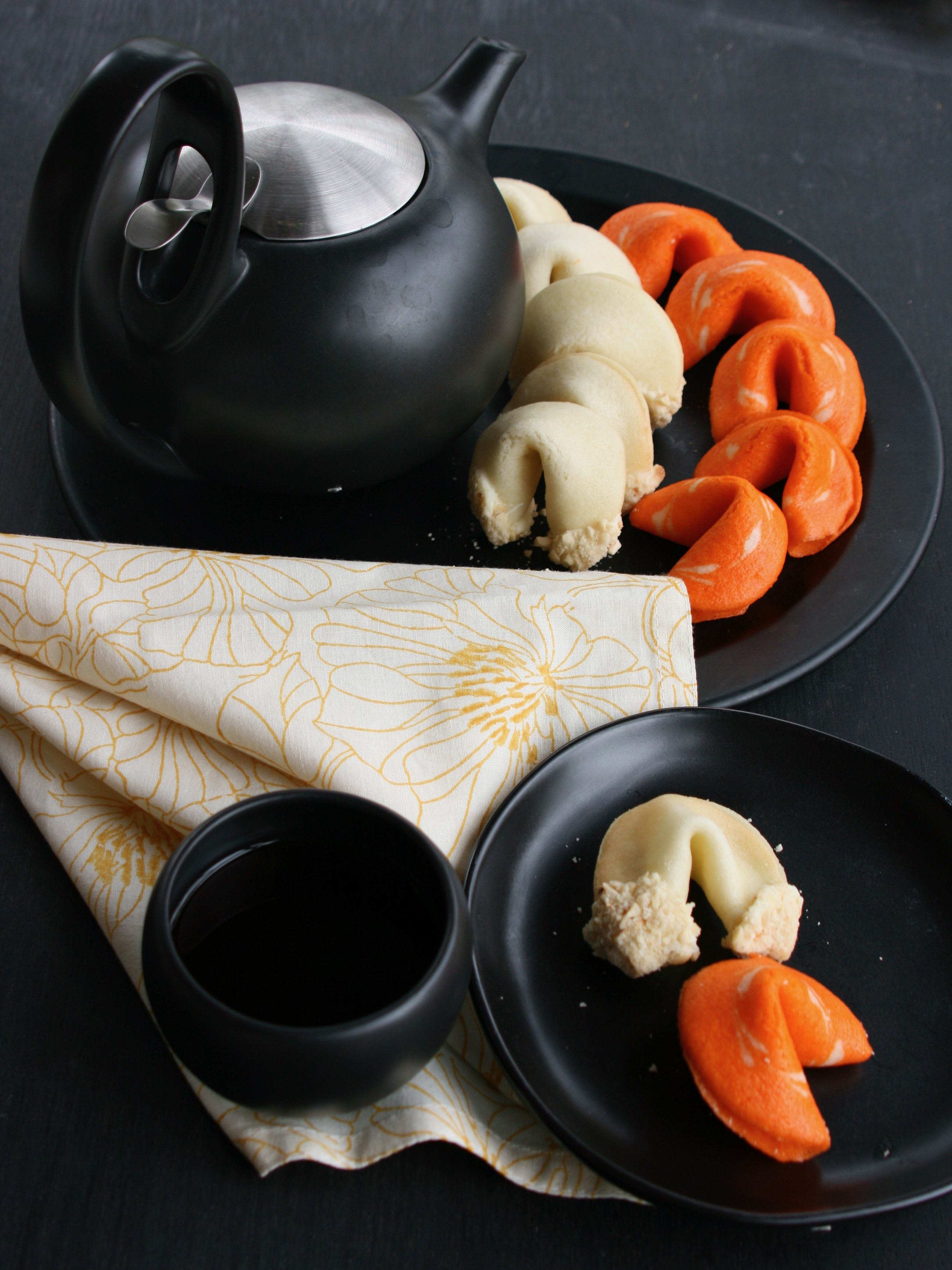
I had planned to share these sweet little confections with my daughters and son-in-law, but I soon realized that a dozen fortune cookies don’t last very long in this household. My husband ate most of the orange-flavored ones, while I gravitated toward the white-chocolate-and-hazelnut-dipped almond ones. Even so, the last ones to be eaten stayed crisp in an airtight container for several days.
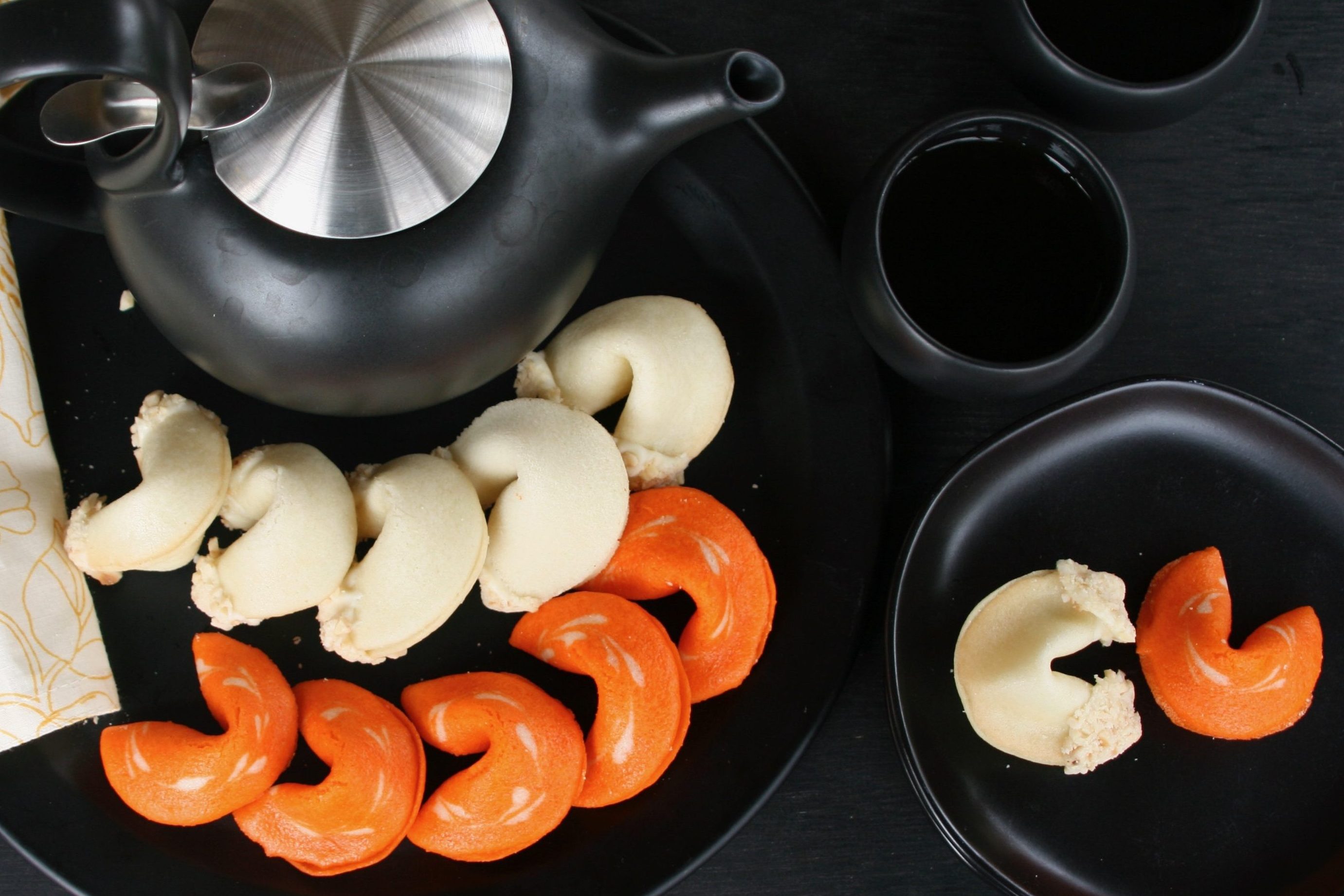
Because you can write your own fortunes, customizing them to the recipient or occasion, these cookies would make great gifts or party favors. You could also make them to celebrate Chinese New Year — just be sure to give a nod to their Japanese roots!
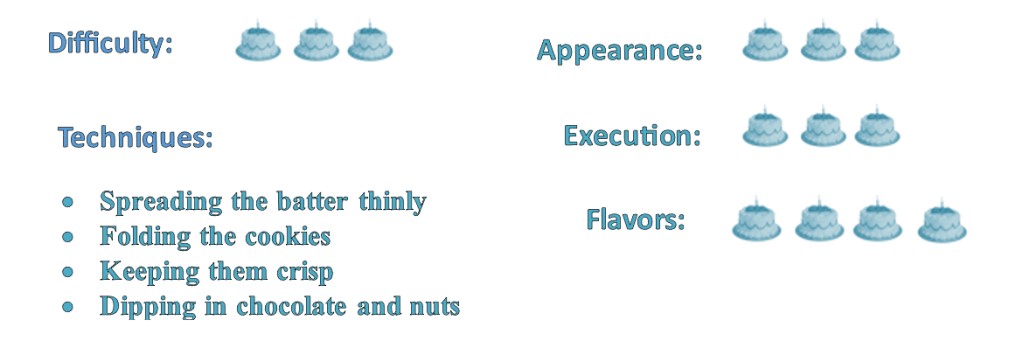
You’ll find Paul Hollywood’s original recipe here, but I’ve adapted it for American bakers below.

Paul Hollywood’s Fortune Cookies
(Adapted for American bakers)
For the cookies:
- 2 large egg whites
- 3 T. vegetable oil
- 1 T. water
- ½ c. all-purpose flour
- 1½ t. cornstarch
- Pinch of salt
- ½ c. superfine (baker’s) sugar
- 1 t. almond extract
- 1 t. orange extract (or a few drops of orange oil)
- Orange food-coloring gel
For decoration:
- 5 oz. white chocolate
- 1½ oz. toasted hazelnuts, chopped
Directions
- First, prepare the fortunes by cutting out 12 small strips of paper, about 2½ inches by ½ inch. Write a short saying or prediction on each one. Preheat oven to 300°F.
- Whisk together egg whites, oil and water until frothy (but don’t incorporate too much air; you don’t want peaks forming).
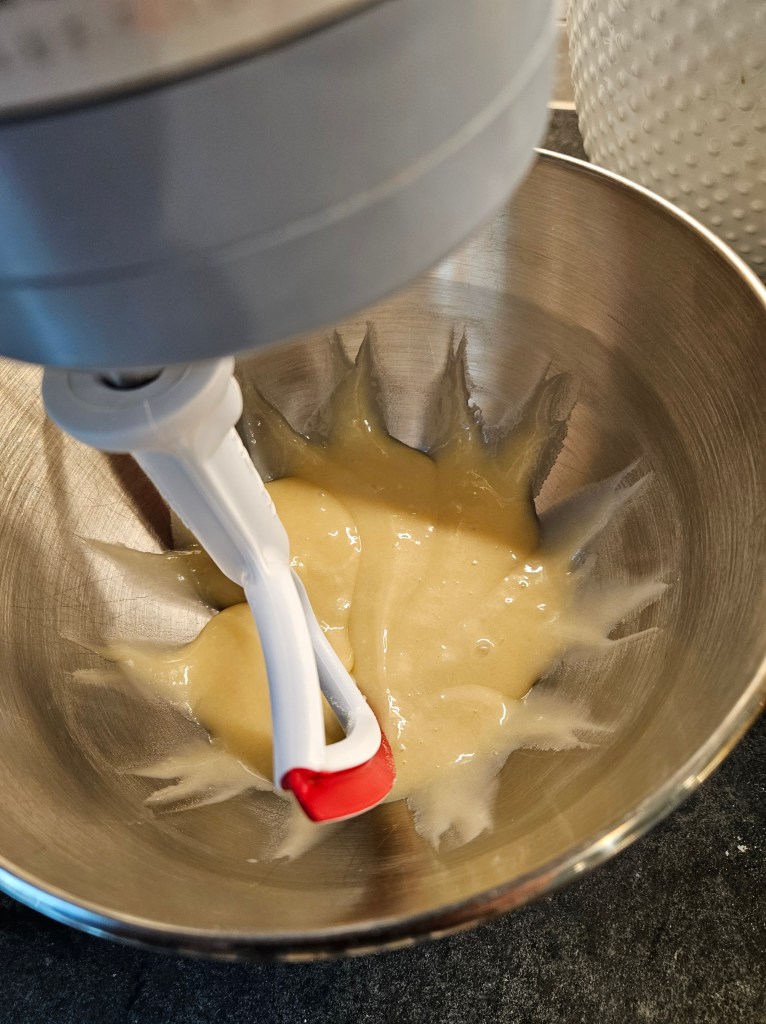
- In a separate bowl, sift together flour, cornstarch and salt; then stir in the sugar. Add egg white mixture to flour mixture and beat until smooth. Try not to incorporate any air into the batter while beating. (You don’t want bubbles in the batter.)
- Divide the batter equally into two bowls. To one bowl, add the almond extract and stir together, then set aside.
- Prepare a medium-sized piping bag with a small round tip, or use a ziplock bag. Transfer 2 tablespoons of batter from the second bowl to the piping bag and set aside. Add orange extract (or oil, a drop or two at a time) to the remaining batter in the bowl, along with some of the orange food coloring. Mix well, adding coloring and stirring until the batter is bright orange. (If using orange oil, taste to see if you need to add another drop or two of orange oil. Be careful not to overdo it.)
- Line a baking sheet with a silicone mat or parchment paper. For the almond cookies, place 1 tablespoon of almond batter on the prepared baking sheet, and use the back of a metal spoon to spread it into a circle about 3½-4 inches in diameter. Repeat with another tablespoon of batter, leaving a space between the two circles. Bake these two cookies for 10-12 minutes until the outer edge is light golden brown.
- Have a drinking glass and a standard-size muffin tin at the ready. Remove baking sheet from the oven and, working quickly, loosen both cookies from the mat with a metal spatula. Lift one cookie off the mat, flip it over and place a fortune in the center, then fold the cookie in half and pinch the edges together. Place the folded edge over the rim of the drinking glass and gently pull the corners down, one on the inside of the glass and one on the outside, to form the classic fortune-cookie shape. Place the cookie in the muffin tin to cool, and repeat the folding process with the second cookie.
- Let the baking sheet cool for a few minutes, then spread, bake and shape another two cookies. (HINT: Wipe the spatula clean between batches.) Repeat with the remaining almond batter, making a total of 6 almond fortune cookies.
- For the orange cookies, make two circles of batter on the prepared baking sheet, using 1 tablespoon of batter for each, just as for the almond cookies. Using the batter in the piping bag, pipe 6-10 dots around each circle, about ½ inch from the edge. (If using a ziplock bag, simply snip a small hole in the corner of the bag to pipe the batter.) Place a toothpick in the middle of one of the white dots and drag the toothpick to the next dot and then the next, without lifting it up (like playing dot-to-dot), until you have drawn a circle passing through all the dots. Bake and shape the orange cookies, two at a time, like you did the almond cookies, making a total of six orange cookies, as well.
- Turn off the oven and wait for it to cool to 200°F. (If you don’t have an oven thermometer, let the oven cool down, then set the oven temperature to 200°F. When it reaches 200°F, turn it off.) Place the muffin tin with the folded cookies into the warm oven. Leave them in the oven (with the oven off) for at least an hour. (Watch to see that they don’t get too brown.)
- Remove the muffin tin from the oven and transfer the cookies to a cooling rack. While cookies are cooling, melt the white chocolate according to package directions. Dip the ends of each almond cookie in chocolate and then in the toasted, chopped hazelnuts. Leave cookies on rack until chocolate is set, then keep in an airtight container until ready to serve.
Up next: Tea Cakes
Discover more from Here's the Dish
Subscribe to get the latest posts sent to your email.
