
Is a pastry defined by its filling or its outer shell? That is the question we must ask when determining the origins of the sfogliatella. To me, the answer is obvious: the outer shell. After all, a profiterole can be filled with almost any kind of cream, jam, or ganache, but its defining element is the pâte à choux, or choux pastry, which creates the vessel that holds the filling. Similarly, Danish pastries can be filled with fruit, jam, cream cheese, or even chocolate, but they are all made with the yeast-leavened, laminated dough called puff pastry.
So when it comes to the invention of the sfogliatella, we are told it was created by a nun at the Santa Rosa convent on Italy’s Amalfi Coast in the 17th century. Not wanting to throw away some semolina that had been cooked in milk, the story goes, she added dried fruit, sugar, and limoncello and baked it between two sheets of pastry shaped to look like a monk’s hood. She served it to her Mother Superior, who decided it was good enough to sell to the local villagers and named it after the convent itself — the Santarosa.
But this sfogliatella Santarosa, as it was later called, was very different from the sfogliatelle that have become synonymous with Naples. The original Santarosa sfogliatella was made with shortcrust pastry, not the thin-layered laminated dough used for “curly” sfogliatelle riccia that are attributed to Pasquale Pintauro, a Naples innkeeper turned pastry chef. And the Santarosa’s topping of soft custard and black cherries has all but disappeared from the Neapolitan version.

It was in the early 19th century, nearly 150 years after the invention of the Santarosa pastry, that sfogliatelle as we know them appeared in Naples. Pintauro is said to have acquired the recipe from an aunt who happened to be a nun. But while they share a name and a semolina-based filling, that seems to be where the similarity between the two pastries ends. (Another version of sfogliatelle, called sfogliatella frolla, which came along later, retains the original shortcrust pastry and semolina filling of the Santarosa pastry.)
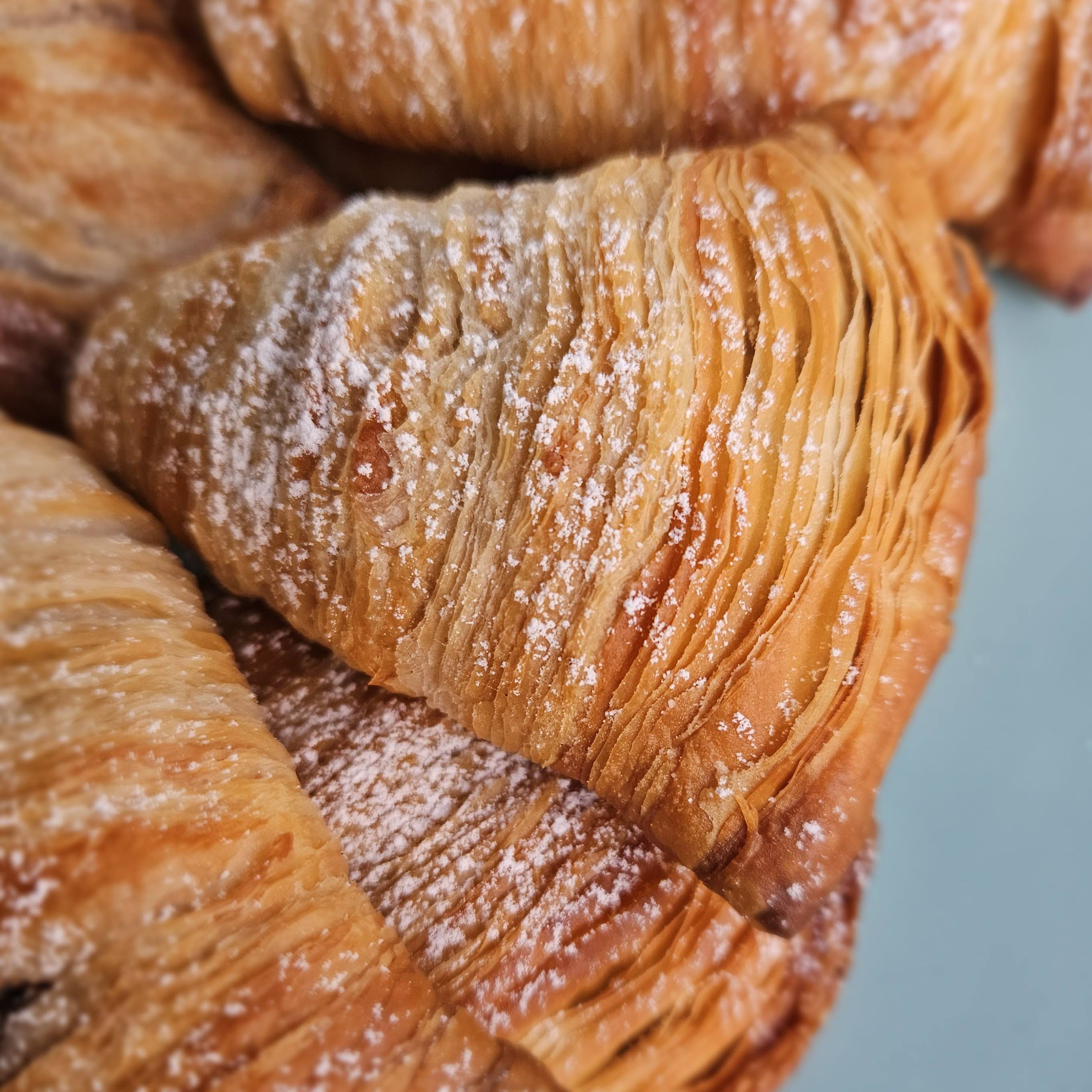
Rather than a shortcrust pastry, the dough for sfogliatella riccia, the version I am sharing with you here, is spread paper thin, slathered with lard and rolled into a log. When the log is sliced, each piece is flattened so that the individual layers spread apart like a fan, creating a cone-shaped pocket, which is then filled, sealed and baked. The resulting seashell-shaped pastry is golden brown, delicate, and delightfully crunchy, with a creamy filling often flavored with candied orange peel and fragrant spices.
Because Steven’s sfogliatelle were pronounced “authentic” by the judges in the Great White Tent, I used his recipe for the dough, with the addition of a little honey, which is recommended by Italian-American food blogger Marcella Cantatore to give the dough a bit of sweetness and help it brown in the oven. Otherwise, it’s a simple dough of bread flour, salt, and water. Bread flour has a higher protein content than all-purpose (plain) flour, so the dough is able to develop more gluten, giving it the stretchiness needed to create such thin layers.
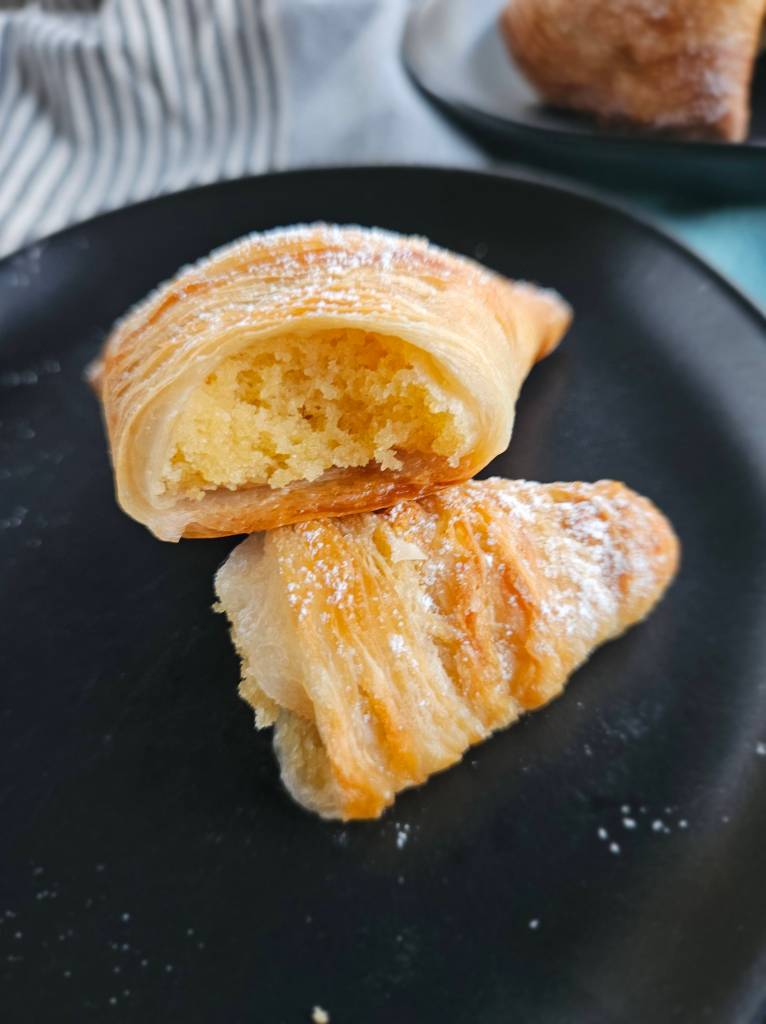
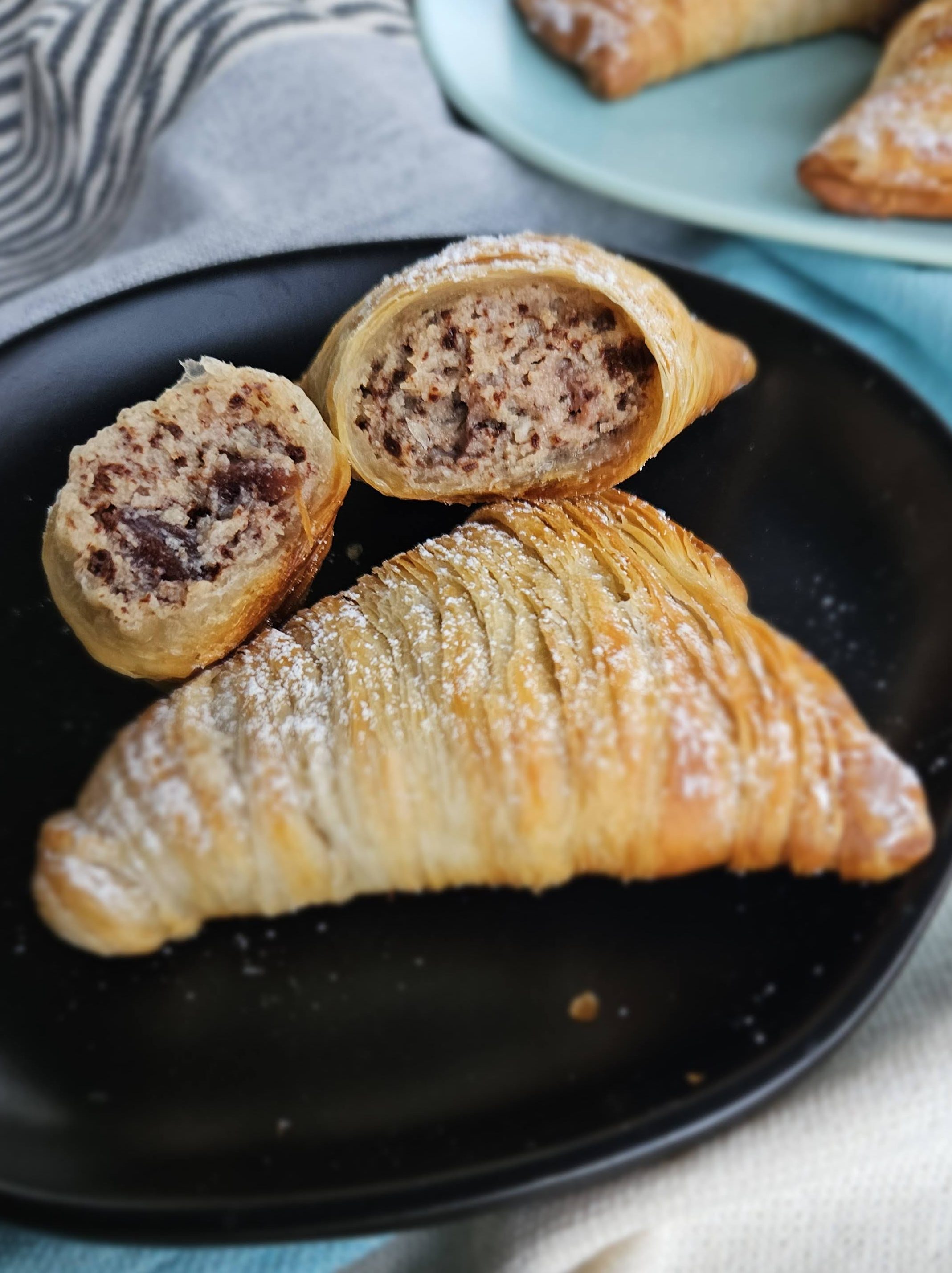
The Bake Off judges requested 24 sfogliatelle with two different fillings, so I chose one with a traditional semolina and ricotta cheese base, adding chopped Amarena cherries and dark chocolate instead of citrus peel. And for the other 12 pastries, I decided to use a French almond cream similar to that used in almond croissants.
Making sfogliatelle is quite a production, but fortunately it can be done in stages over a few days. Making the dough in advance and leaving it to rest in the fridge gives the gluten time to relax, giving it even more elasticity. The semolina filling can also be made up to three days ahead of time. Here’s how I divided the project into three days:
- Day 1 — Make the dough and the chocolate-cherry filling.
- Day 2 — Stretch the dough and roll it up.
- Day 3 — Make the almond filling; assemble and bake the pastries.
Using a stand mixer fitted with a dough hook makes the first step — making the dough — quite easy. After the first overnight rest comes the labor-intensive part — stretching the dough paper thin and rolling it up like a Swiss roll. I knew I would need to purchase a pasta machine for this bake, but fortunately, there are a lot of them available on eBay in like-new or gently used condition.
Working with small portions of dough at a time, I ran it through the pasta machine on the widest setting, folded it in thirds, then ran it through again, repeating this step three more times until the dough was smooth and pliable. Then I began reducing the width between the pasta rollers each time, creating a long, thin sheet of dough that was almost transparent.

Spreading it on my kitchen island (Make sure you have a large work surface cleared — at least 4 feet long), I then proceeded to stretch it even more by hand until it had almost doubled in width. Once that piece of dough was 7 or 8 inches wide and 4 to 5 feet long, I spread it with a mixture of lard and butter (another suggestion of Marcella’s — she doesn’t recommend using all butter) and rolled it up from one of the narrow ends, continuing to stretch the dough as I went.
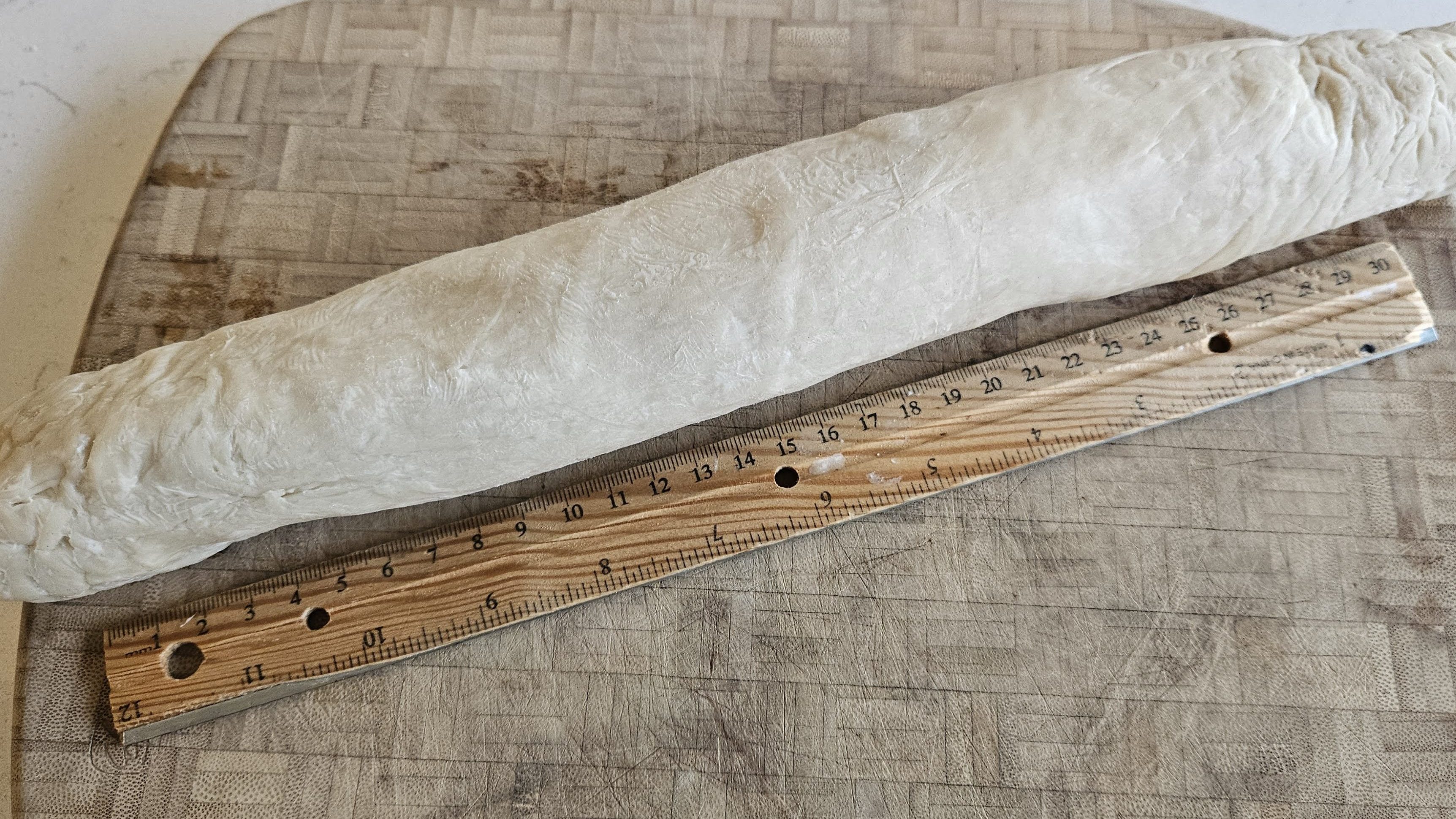
After repeating this process with the rest of the dough and attaching each piece to the previous roll, I had one large log of dough. Even at this stage you can stretch the log to make it longer. You want about a 14-inch log to make 24 sfogliatelle.
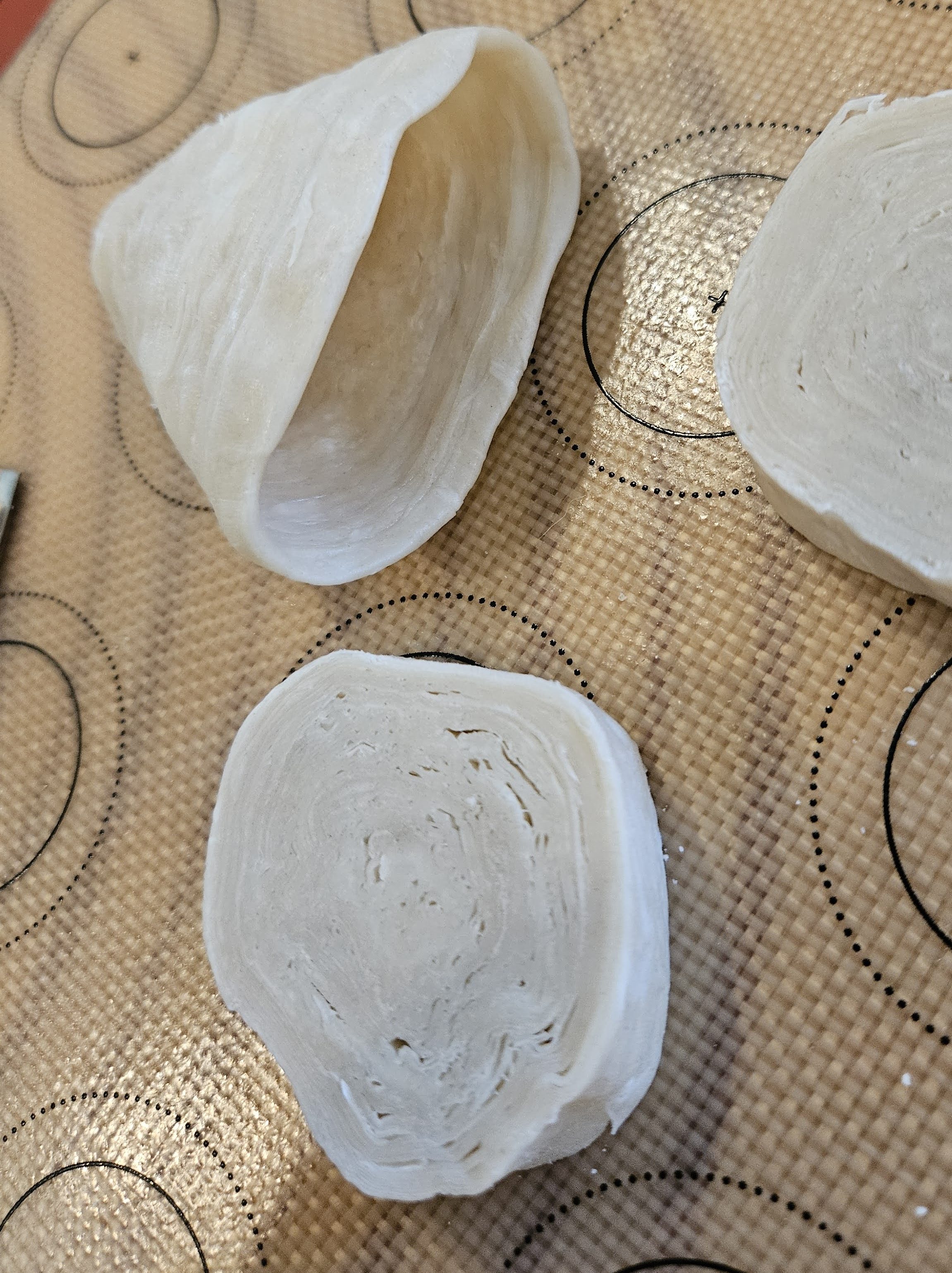
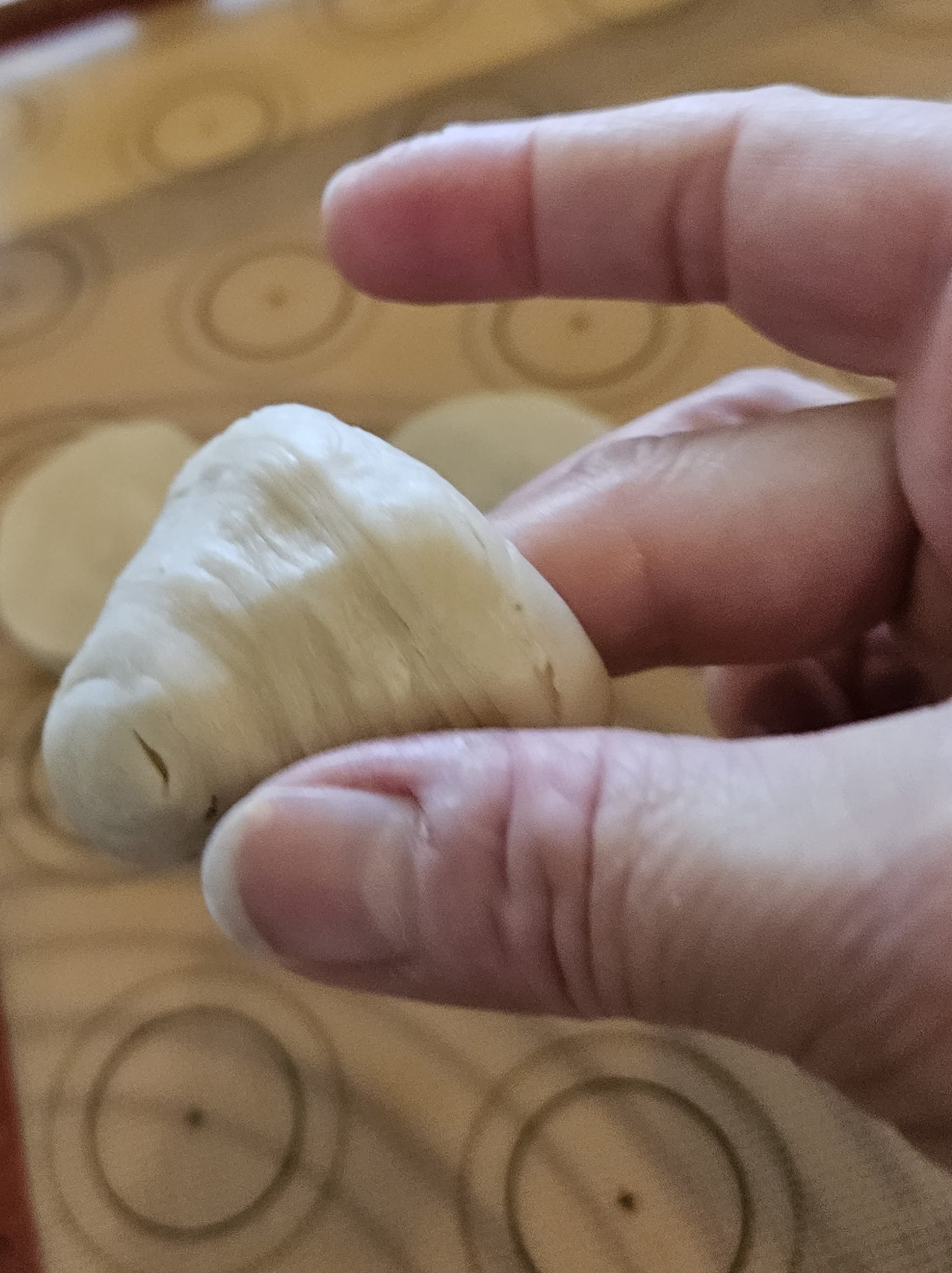
I left the dough log in the fridge overnight, and when I was ready to form the pastries, I cut off the straggly ends and sliced the log into ½-inch disks. Taking one disk at a time, I placed my thumbs in the center and slowly flattened the disk from the center outward, separating the layers and creating a cone-shaped pocket. After piping some of the filling into the pocket, I pinched it closed with my fingers and placed it on the baking tray. When all 24 pastries were assembled, they got one final chill in the fridge for about 20 minutes and then baked at 450°F for 15-18 minutes.

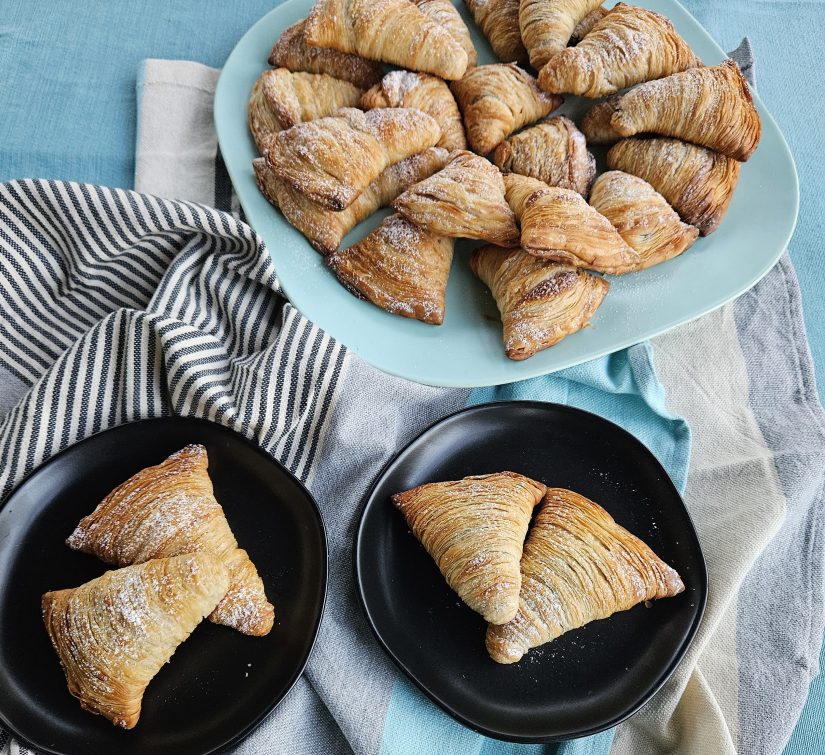
They came out golden and crisp and looked almost as good as the one I bought at an Italian coffee shop a few days earlier (strictly for research purposes, of course). With such a large batch, I was glad to be able to share them with friends and family. Everyone gave them rave reviews!
Making these pastries could be a family affair, with everyone taking turns rolling and stretching the dough. The process is forgiving enough that even little kids could be involved. (A few rips or holes in the dough won’t be noticed in the end product.) These may not make it onto my regular baking rotation, but they could become a family tradition!


Sfogliatelle With Two Fillings
Credit for almond cream: SeriousEats.com
For the pastry:
- 3 2/3 c. bread flour
- 1 t. salt
- 1 c. water, divided
- 1 T. honey
- 6 T. butter, softened
- 6 T. lard, room temperature
For the chocolate-cherry filling:
- ½ c. ricotta cheese
- ½ c. whole milk
- ¼ c. superfine (baker’s) sugar
- 1 pinch salt
- 2 T. semolina
- 1 egg yolk
- 2 t. Amarena cherry syrup
- ½ t. vanilla extract
- 1/8 t. almond extract
- 1½ oz. dark (70%) chocolate, finely chopped
- 2 T. finely chopped Amarena cherries
For the almond cream filling:
- 1 c. blanched almond flour
- 6 T. unsalted butter, room temperature
- ½ c. granulated sugar
- 2 T. all-purpose flour
- 1 large egg, room temperature
- 2 t. almond extract
- ½ t. vanilla extract
- ¼ t. salt
For assembly:
- 6 T. butter, softened
- Powdered sugar, for dusting
Directions
- To make the dough, sift flour and salt into the bowl of a stand mixer fitted with a dough hook. Make a well in the center and, with the mixer on its lowest setting, pour in ¾ cup of water and the honey. As the dough starts to come together, gradually add more water, up to about ¼ cup, to make a firm dough. Raise the speed to medium and mix for 3 more minutes. The dough should form a ball but won’t look totally smooth.
- On a lightly floured work surface, cover dough with an upturned bowl and leave to rest for 5 minutes. Knead for 3 minutes, then cover with the bowl and rest 5 more minutes. Repeat once more until the dough is smooth and pliable, then divide it into eight pieces, wrap each in plastic wrap, and refrigerate for 2 hours (or overnight).
- To make the chocolate-cherry filling, first line a sieve with cheesecloth or muslin and set it over a bowl. Put the ricotta into the cheesecloth, using the excess cloth to cover the cheese. Set a small saucer on top, then place a heavy weight (like a can of food) on top of the saucer. Refrigerate for at least 1 to 2 hours (or overnight) to drain.
- Pour the milk into a medium saucepan, add the sugar and salt, and bring to a boil. Over medium-low heat, sprinkle in the semolina, stirring continuously for 2 to 5 minutes until the mixture is very thick. Transfer to a heat-proof bowl, press a piece of plastic wrap onto the surface to prevent a skin from forming, and leave until cool.
- Tip the cooled semolina mixture into the bowl of a stand mixer fitted with a whisk attachment. Mix on medium-high speed until very smooth. Add egg yolk, cherry syrup, extracts, and drained ricotta and beat until very smooth, then stir in the chocolate and cherries. Transfer to a piping bag with a plain round tip and chill until ready to assemble (up to three days).
- To begin stretching the dough, first mix 6 tablespoons of butter and 6 tablespoons of lard together and divide into eighths.
- Working with one piece of dough at a time, knead it into a flat disk. With the pasta roller at its widest setting, run the dough through the roller, then fold it in thirds, turn it 90 degrees, and run it through again. Repeat this three more times until the dough is very smooth and pliable. Adjust the rollers to the next widest setting and run the dough through again. Keep rolling the dough through the machine, decreasing the width each time, until it’s on the narrowest setting.
- Place the strip of dough on your work surface and gently stretch it, working from one end to the other, to double its width. The dough will be an odd shape and may tear, but that’s fine. Brush very lightly with 1/8 of the lard-butter mixture.
- Starting at one end, tightly roll up the dough like a Swiss roll, slightly stretching it by pulling toward you as you go. The roll will be thicker in the middle with two straggly ends. Gently pull the ends to make the roll a bit longer and thinner. Cover with plastic wrap while you work on the next portion.
- Roll out the second portion of dough exactly as before and brush it with the lard-butter mixture. Place the previously rolled dough at one end of the new strip, overlapping by about an inch. Continue rolling the new strip onto the roll, pulling and stretching the roll as you go.
- Repeat with the other portions of dough, making one big roll. Then gently pull, squeeze and stretch the roll until it’s about 14 inches in length with straggly ends. Brush the whole roll with softened butter, wrap it in plastic wrap, and leave in the fridge for at least two hours, preferably overnight.
- To make the almond cream, first preheat the oven to 350°F. Spread the almond flour onto a parchment-lined, rimmed baking sheet in a thin, even layer and toast it in the oven, stirring every 3 minutes until the flour is fragrant and light golden brown, about 10 minutes. Remove from the oven and cool to room temperature, about 20 minutes.
- In the bowl of a stand mixer fitted with a paddle attachment, beat the butter and sugar on low speed to combine. Then increase speed to medium-high and beat until smooth and creamy, about 3 minutes, pausing to scrape down bowl and beater as needed. Add the almond flour, all-purpose flour, egg, almond extract, vanilla, and salt. Mix on medium-high speed for about two minutes until mixture is smooth, thick, and creamy, pausing to scrape down bowl and beater halfway through.
- Use a spatula to scrape the bowl and beater again, making sure no streaks of unmixed butter remain. Transfer mixture to a pastry bag fitted with a plain tip. (This will make more than needed for 12 sfogliatelle. Leftover filling can be baked in tart shells or puff pastries. If refrigerated, bring to room temperature to soften.)
- To assemble the pastries, unwrap the roll of dough and cut off the straggly ends. Cut the roll into disks about ½-inch thick. Grease your fingers with a little bit of the softened butter, reserving the rest for later. Holding a disk between your thumbs and forefingers, gently start to separate the layers — starting from the center and working out to the edges — to form a cone shape, with the center of the disk making the point, creating an opening of about 2½ inches in diameter.
- Pipe filling into the cone up to ½ inch from the opening, making sure it reaches down into the tip of the cone. Gently pinch the opening to seal it. Repeat with the remaining disks, filling half with the chocolate-cherry filling and half with the almond cream. Transfer the pastries to parchment-lined baking sheets and refrigerate for 20 minutes or until firm.
- Preheat oven to 450°F. Melt the remaining softened butter. Remove pastries from fridge and brush with the melted butter. Bake for 10 minutes, then rotate the baking sheets and reduce temperature to 425°F. Bake for 5-8 minutes more, until golden and crisp. Transfer pastries to a wire rack, dust with powdered sugar and leave to cool. Best served while still warm, sfogliatelle can be rewarmed in a 350°F oven for a few minutes.
Discover more from Here's the Dish
Subscribe to get the latest posts sent to your email.
