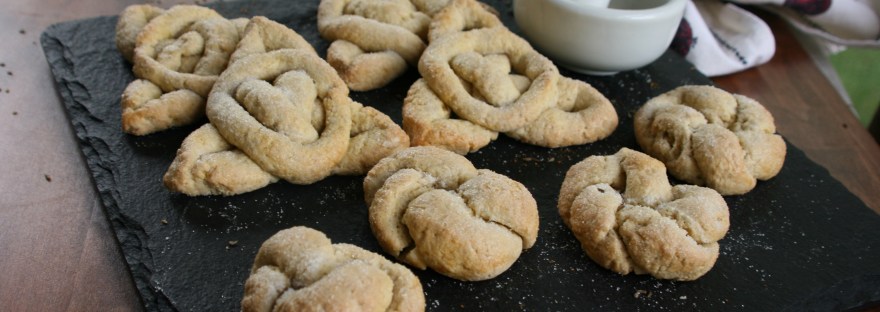
Jumbles have been around since medieval times, in one form or another, having moved from the Middle East to Europe via the Moors in Spain, who brought their signature flavors of rosewater, caraway and aniseed to the mix. Even the name has been jumbled around, varying from jambles to jumbals, jumballs, jumbolls or jumbolds to jemelloe. And they are probably related to Italian gemelli and the French gimlette.

These sweet biscuits are inextricably tied to the English Tudor period (as this was the Bake Off technical challenge for Tudor Week), not only because the first known published recipe for “jombils” appeared in 1585 in The Good Huswifes Jewell by Thomas Dawson, but also in legend, dating back to the War of the Roses, which ushered in the reign of the Tudors in 1485.
In August of 1485, King Richard III gathered his army in Leicester, preparing to face Henry Tudor in the Battle of Bosworth, fighting for his very crown. On the morning of the battle, so the legend has it, Richard’s cook baked some jumbles for the king to carry in his pouch so he would have something to eat if there were a break in the fighting. Alas, Richard rode into battle before the jumbles were ready, and he died that day on the battlefield. When the conquering army raided Richard’s camp, of course they scarfed down the jumbles and preempted the recipe, which is why these biscuits are often called Bosworth Jumbles today.
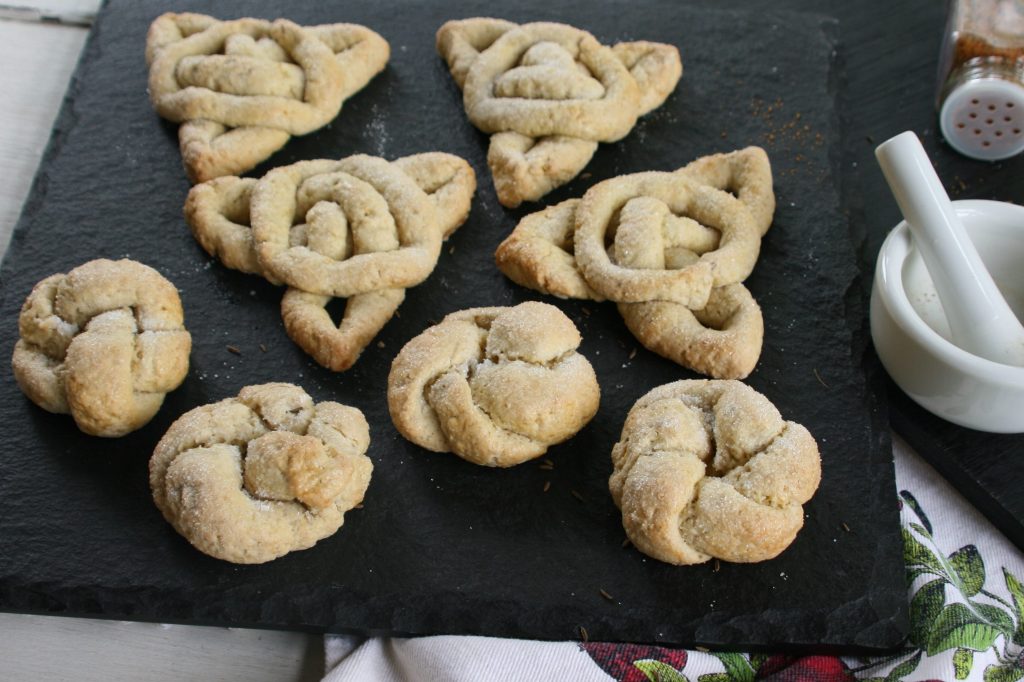
Jumbles are also considered the precursor to our sugar cookies of today. They are denser than modern cookies, having been invented before the introduction of baking powder, but they were also known to be sturdy enough to keep for a year or more, making them a popular food for travelers.
Early recipes call for the dough to be shaped and then boiled before baking. More recent recipes — including Paul Hollywood’s, which we’re using here — have dropped that step. (I wonder, though, if boiling them would give them a smoother, shinier surface, rather like a bagel. Mine appeared somewhat dry and cracked.)
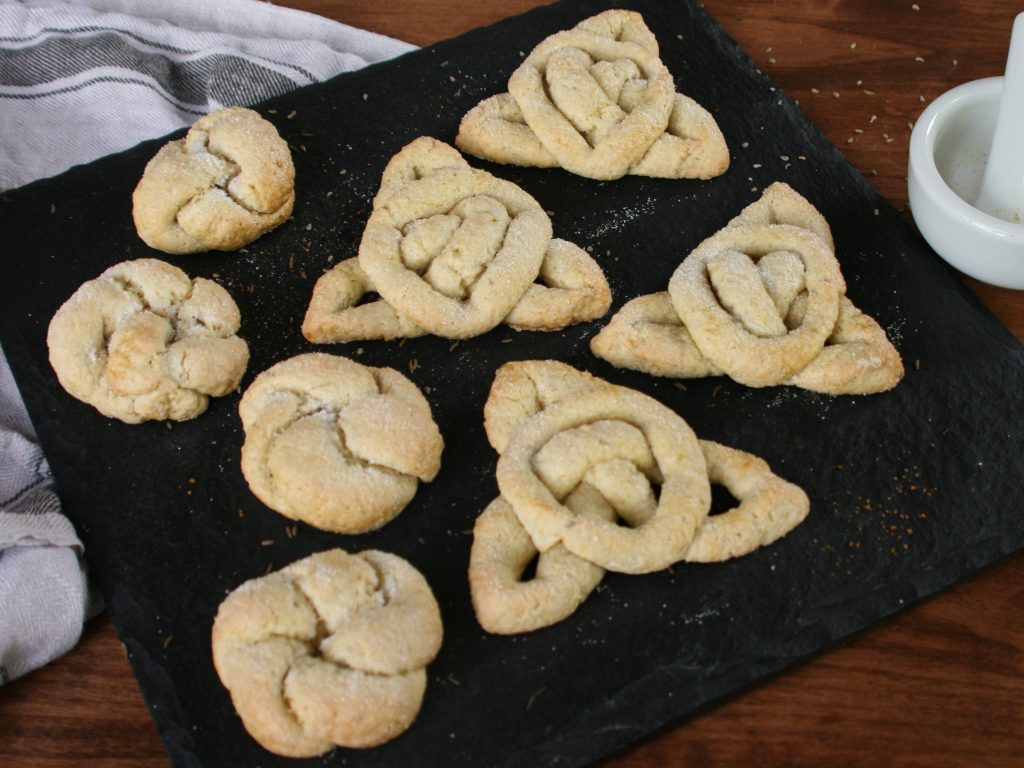
The shape of jumbles has morphed over time, as well. Originally, they may have been made into rings, but pretzel-shaped knots and S shapes were also popular. Anything goes, really, but Paul asked for four double knots and four Celtic knots.
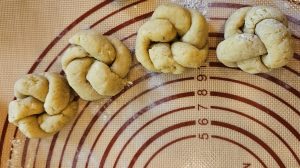
Shaping them was the most difficult part of this recipe, for me. Paul explains a little bit how to make each of the shapes here (Skip to 2:40 in the video.), but I couldn’t find any videos or tutorials online demonstrating the technique. I ultimately figured it out on my own, and I’ve tried to include photos showing how I went about it. (See below.)



This recipe combines the flavors of caraway, aniseed (sold here in the U.S. as “anise seed”), mace and lemon zest. I usually associate caraway more with savory dishes than sweet, and I’m not a big fan of the licorice flavor of anise, but the combination of these flavors is mildly reminiscent of nutmeg and reminds me of a sugar cookie recipe my mom used to make that called for sour cream and nutmeg.
Because of their density, these biscuits would be good for dunking in your favorite tea or other hot beverage — or even a dessert wine. They are robust and filling so could work just as easily as a breakfast cookie or a fortifying snack.

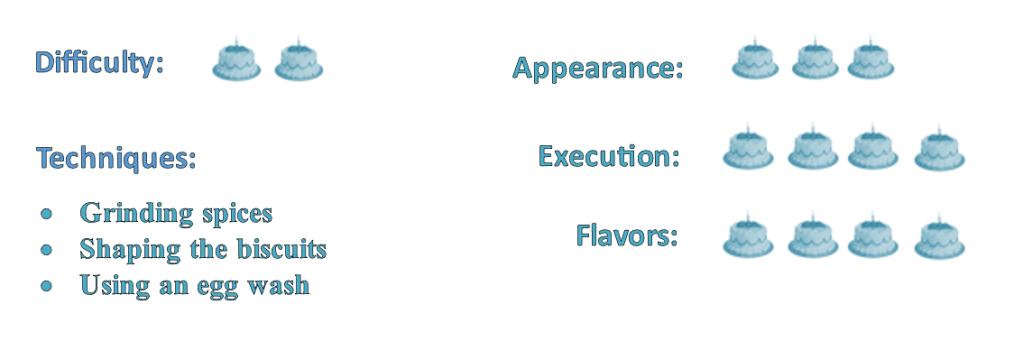
You can find Paul’s original recipe here, but I’ve adapted it for American bakers below.
Paul Hollywood’s Jumble Biscuits
(Adapted for American bakers)
For the dough:
- 1 t. caraway seed
- ½ t. anise seed, ground or whole
- ½ t. ground mace
- 3 c. all-purpose flour, plus extra for dusting
- 4½ T. unsalted butter, chilled
- 2/3 c. + 1 T. granulated sugar
- Zest of 1 large or 2 small lemons
- 3 large eggs, lightly beaten
To finish:
- 1 large egg, lightly beaten
- Granulated sugar, for sprinkling
Directions
- Line two large baking sheets with parchment paper. Place the caraway and anise seeds (if whole) in a spice grinder or mortar and pestle, and grind to a powder. Sift the caraway, anise seed, mace and flour together into a mixing bowl.
- Cut the butter into cubes and rub it into the flour until it resembles fine bread crumbs, then stir in the sugar and lemon zest. Add the lightly beaten eggs and bring the mixture together to form a soft dough.
- Divide the dough into four balls weighing 2½ ounces each and four balls weighing 3 ounces each. (I had enough left over to make an extra Celtic knot and a small double knot.) Place the dough balls on one of the prepared baking sheets, cover with plastic wrap and chill in the fridge for 30 minutes. Preheat the oven to 350°F.
- Remove the four smaller knots from the fridge, and knead them on a lightly floured surface until pliable. Using your fingertips, roll each one into a 12-inch rope and form it into a double knot (see photos above). Place them on one of the lined baking sheets, brush with beaten egg and sprinkle with sugar. Bake for 20-25 minutes until golden-brown.
- While the knots are baking, roll the four larger pieces of dough into 16-inch ropes, then cut four inches off one end of each. Form into Celtic knots (as pictured above), using the smaller piece of rope to make the circle that sits on top of the leaf-shaped triangle. Place the Celtic knots onto the other lined baking sheet, brush with beaten egg and sprinkle with sugar. Bake for 15-20 minutes until golden-brown.
- When jumbles are done, remove from the oven and leave to cool on a wire rack. They will keep in an airtight container for at least a week (but I wouldn’t guarantee a whole year).
Up next: Marchpane
Discover more from Here's the Dish
Subscribe to get the latest posts sent to your email.
