

Depending on where you are in the world, teacake can mean very different things.
In the Southern U.S., a teacake is a large, dense sugar cookie reminiscent of the “cakes” served by white women to their guests for tea but made by enslaved African-American women in plantation kitchens during the antebellum era. In Scotland, the image most likely to come up when mentioning teacakes is a Tunnock’s Teacake — a chocolate-enrobed marshmallow with a crisp cookie base.
Even in England, the form that a teacake takes varies with the region one hails from. In Yorkshire, Cumbria and East Lancashire, a teacake is a plain round bread roll made from enriched dough. But in the rest of Britain, the term generally refers to a flattened, round yeasted bun with dried fruit like raisins and candied citrus peel throughout.
And in the rest of the world, it can pretty much mean anything served with a cup of tea.
Needless to say, this all caused quite a bit of confusion when teacakes were the signature challenge for bread week on the Great British Bake Off.
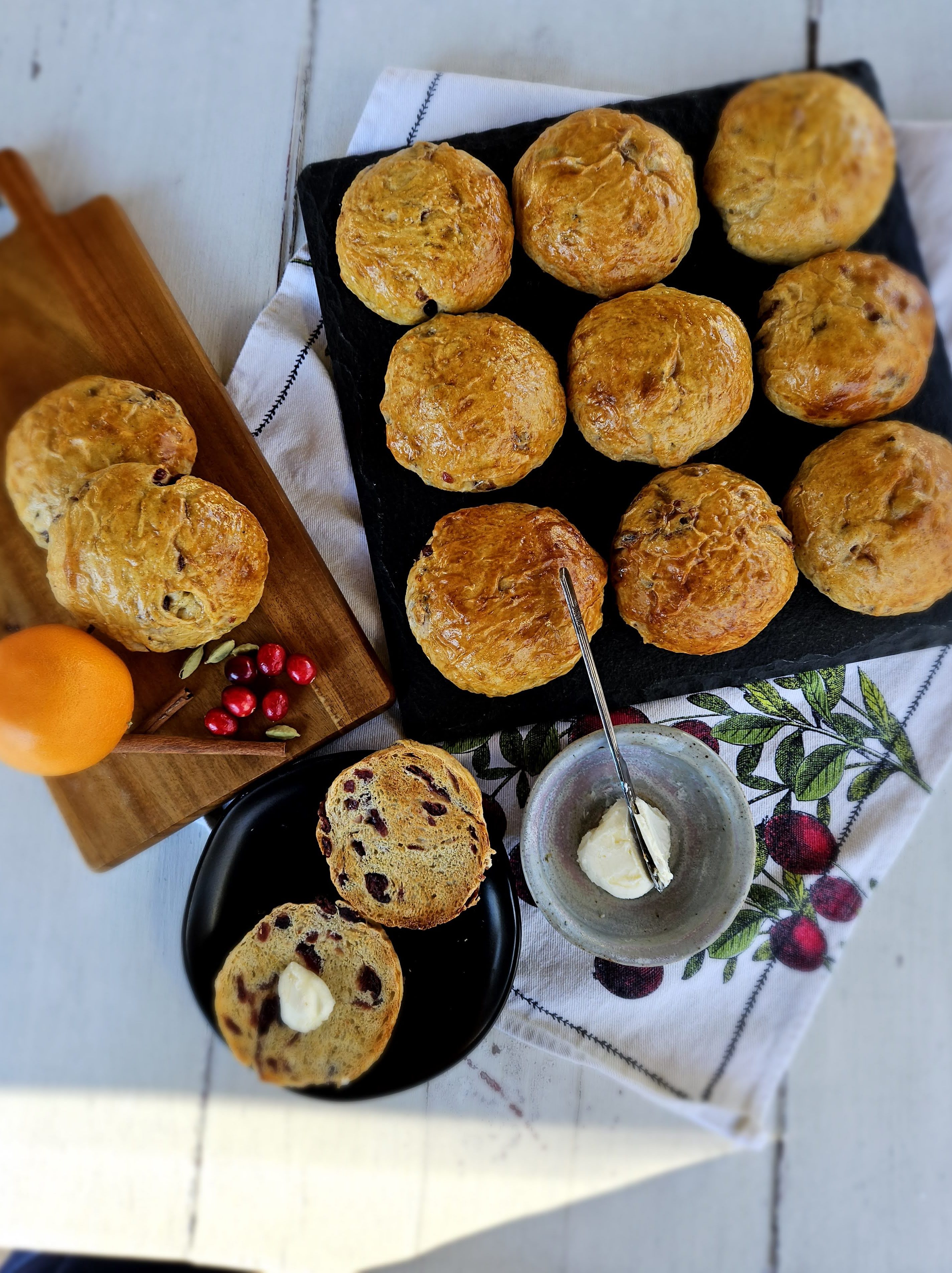
But for the purposes of this blog, we will be following their lead and sticking with the English version. Something like a cross between a bagel and a hot cross bun, these fruited yeast rolls are generally sliced in half horizontally, toasted, and slathered in butter. They are then served for breakfast or tea alongside a steaming hot cuppa.

My version is pretty straightforward, an orange-scented bun studded with dried cranberries and warmed with spices like cardamom and cinnamon. Both James and Steven used this flavor combination in their teacakes. While Steven’s were underproved, James’ were praised for his “perfect” proving as well as baking. Paul even said they tasted fantastic.
For my teacakes, I’ve borrowed Paul Hollywood’s recipe from his book How to Bake, but I swapped out the sultanas and mixed peel for dried cranberries. I infused the fruit with spiced rum and orange juice by soaking them overnight, resulting in plump, juicy cranberries. I also added orange zest and the warmth of cardamom to the dough.
The finished buns, warm from the oven or toasted to a golden brown, taste of Christmas mornings from the not-too-distant past, when we’d all take our breakfast into the family room as we gathered around the tree, the adults sipping their coffee while the children, too excited to eat, held their breath with anticipation to see what Santa had brought.


Cranberry Orange English Teacakes
To prepare the fruit:
- 2/3 c. orange juice
- 1 t. mulling spices*
- ¼ c. rum
- 1½ c. dried cranberries
- 2 t. plain flour
For the dough:
- 5½ c. bread flour
- 1½ t. salt
- ½ c. superfine (baker’s) sugar
- 1 t. cardamom
- ½ t. cinnamon
- Zest of 3 large oranges
- 3¼ t. fast-action yeast
- 1/3 c. unsalted butter, softened and cubed
- 1¾-2 c. cool water
- Vegetable oil, for kneading
- 1 egg, beaten, for glazing
Directions
- Combine orange juice and spices in a small saucepan and bring to a boil. Lower heat to a simmer and add the rum. Stir until heated through. Place cranberries in a heatproof container. Pour orange juice mixture through a sieve over the cranberries. Cover and leave overnight.
- The next day, put 5½ cups of bread flour into a large mixing bowl. Add the salt, sugar, spices and orange zest to one side of bowl and yeast to the other. Add the butter and about 1½ cups of water and mix with your fingers. Add more water, a little at a time, until you can form the dough into a ball and pick up all the flour from the sides of the bowl. (You may not need all the water, or you might need a little more.) The dough should be soft but not soggy. Use the mixture to clean the inside of the bowl, and keep mixing until you have a rough dough.
- Coat your work surface with a little vegetable oil, then tip the dough onto it and begin to knead. Knead for 5-10 minutes, working through the initial wet stage until the dough starts to form a soft, smooth skin.
- When the dough feels smooth and silky, put it into a large, lightly oiled bowl. Cover with a towel and leave to rise until at least doubled in size — at least one hour, but it’s okay to leave it for two or three.
- Meanwhile, drain the cranberries and place them on a paper towel to soak up the extra liquid. Line two baking sheets with parchment paper or silicone mats.
- When the dough has doubled in size, toss the cranberries with 2 teaspoons of flour and sprinkle them over the dough in the bowl. Start working the fruit into the dough with your hands. After a minute or two, tip the dough out onto a lightly floured surface and knead until the fruit is thoroughly mixed in.
- Divide the dough into 12 equal pieces. Shape each into a ball, trying to keep the fruit on the inside as much as possible. Flatten each bun slightly with your fingers or a rolling pin into a round bun about ½ inch thick, removing or tucking in any pieces of fruit that stick out. (This will prevent exposed fruit from being overcooked and hardened.) Transfer the buns to the prepared baking sheets, spacing them about 1½ inches apart, and brush them with the beaten egg.
- Cover the teacakes with plastic wrap sprayed with vegetable oil spray and leave to rise for about an hour until they are at least doubled in size. Meanwhile, heat oven to 400°F.
- Bake for 12-18 minutes until risen and golden brown. Cool on a wire rack.
To serve, slice horizontally and toast. Spread generously with butter and preserves, if desired.
*If you don’t have mulling spices, use any combination of: 4 whole cardamom pods (split open by crushing with the flat side of a knife), ½ cinnamon stick, 4 whole cloves, 4 whole allspice.
Up Next: Cottage Loaf
Discover more from Here's the Dish
Subscribe to get the latest posts sent to your email.
