When researching the history of any classic and widely known culinary product, the etymology of the name it goes by may take a totally different route than the development of how it is made. So it is with choux pastry. And, as is also common in many such cases, neither is clear cut.
Tracing the origins of this fairly basic recipe is nearly impossible because “its manufacture is a relatively simple process and it is possible that it was independently created in many places and at various times,” writes David Potter in “Powches, Puffs and Profiteroles: Early Choux Paste Receipts,” an article published in Petits Propos Culinaires in 2003.
“Certainly the idea of cooking a paste of flour, butter and liquid and then adding eggs to produce a small puffed pastry cake was known to some French cooks at the start of the seventeenth century,” he continues. “…But choux paste, though by other names, can be found in even earlier books and manuscripts.” Some of the names found in 16th- and 17th-century English cookbooks include “benets,” “puffs” and “French fritters” or, in French, beignets souffles.
One of the earliest surviving recipes in English for “bennets” is found in A Book of Cookrye published in 1584. According to the 17th-century English diarist John Evelyn, these fritters are of French origin. “However,” Potter writes, “we can find several receipts recognizable as choux paste in the German cook Sabina Welserin’s manuscript of 1553. They are more explicit than any contemporary French manuscripts and indicate long-standing familiarity with the technique.”
So France or Germany or some other country may claim its invention, but its name, at least, is clearly French. That’s about as much as we know, though. Some posit that the moniker “choux pastry” derived from the French word chaud, for “hot,” while others believe it was always called choux, which means “cabbage,” because the free-formed choux buns are shaped like little cabbages.
I’ve explained the science behind why choux pastry works the way it does in my post on éclairs, so I won’t go into much detail here. If you’ve never made it before, I highly recommend reading this blog post or watching this video tutorial.
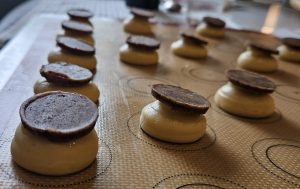
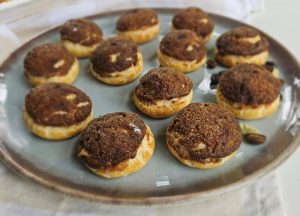
In this Signature challenge, the judges wanted each baker to make two varieties of choux buns (aka cream puffs or profiteroles) — 12 of each — one of which needed to be iced and the other topped with craquelin (aka a choux au craquelin). Craquelin is a simple, cookie-like dough made of butter, sugar and flour that is rolled thin, cut into small circles and placed atop the choux pastry before it is baked. As the choux dough rises and the butter in the craquelin melts, they are molded together so the craquelin forms a lacy, crispy crust on top of the pastry. It also serves to help the choux bun rise into a more uniform rounded shape instead of the irregular bumpy shapes that most people associate with cream puffs. Paul said the choux buns should have “a crispy outside, beautiful and airy on the inside, and the flavors must complement each other.”
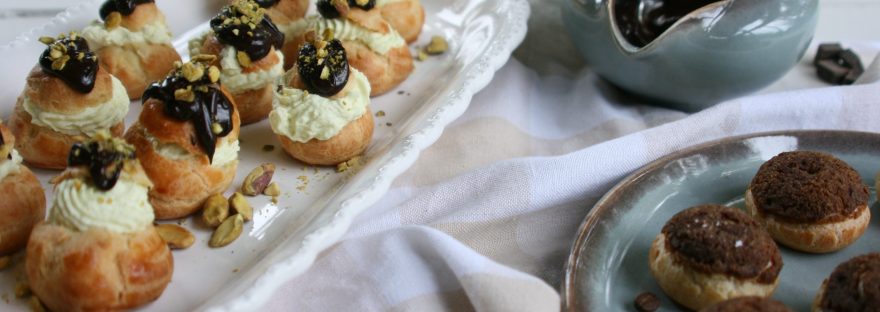
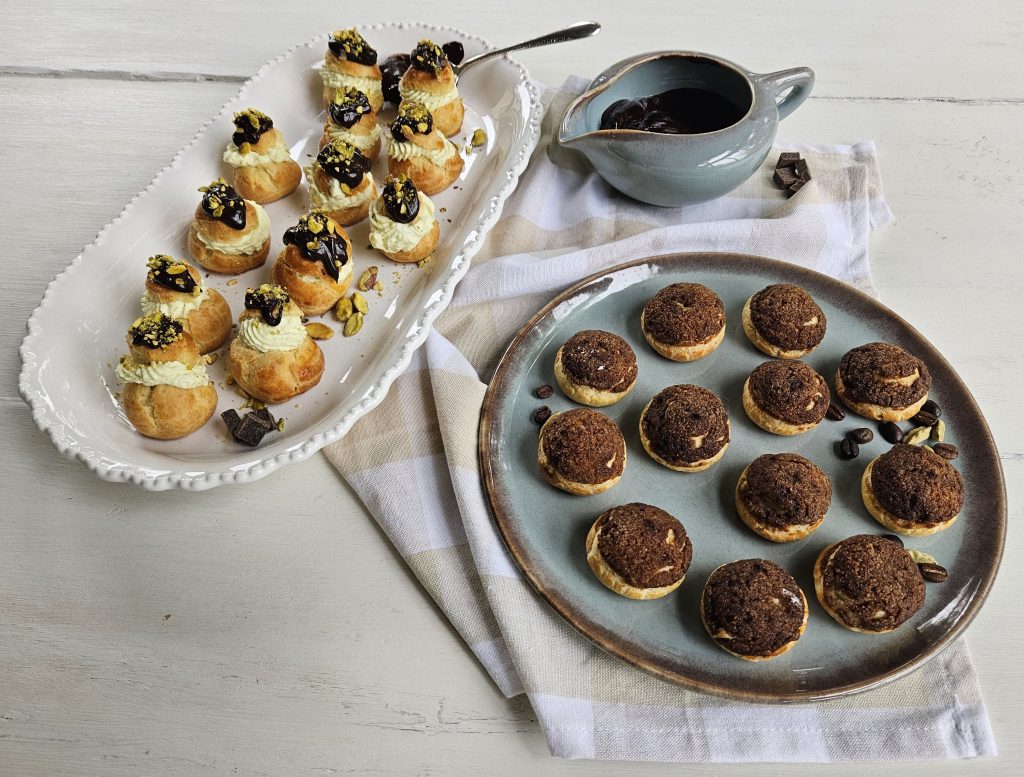
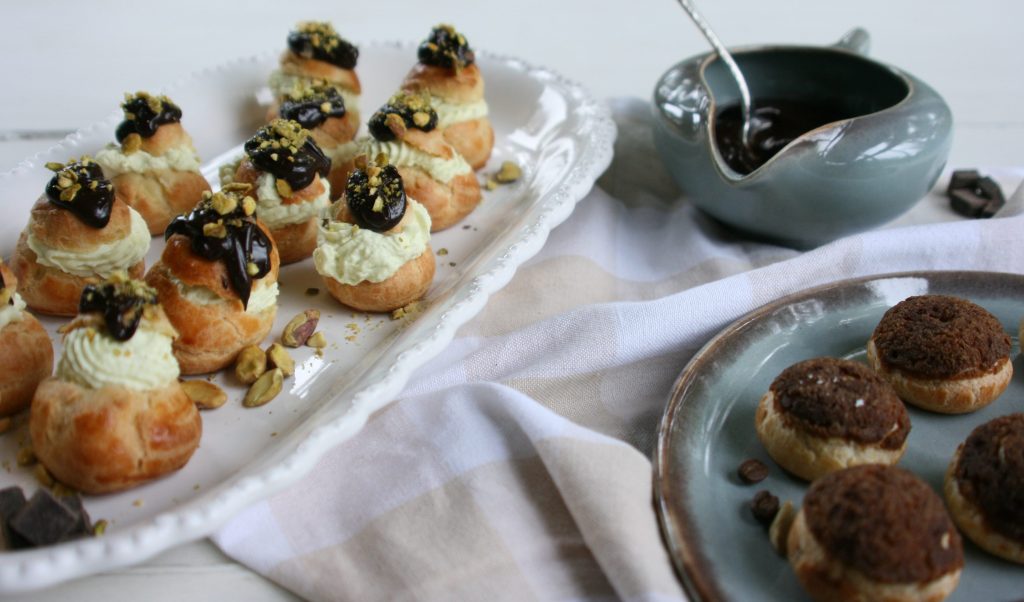
My complementary flavors are coffee-cardamom and pistachio-chocolate. My choux au craquelin is filled with coffee and cardamom pastry cream and topped with a cardamom-scented craquelin. The iced ones are filled with pistachio-mascarpone whipped cream and topped with chocolate ganache and chopped pistachios. I started with Kate’s choux recipe, since the judges liked her choux buns the best. I used her craquelin recipe, too, with the addition of ½ teaspoon of cardamom.
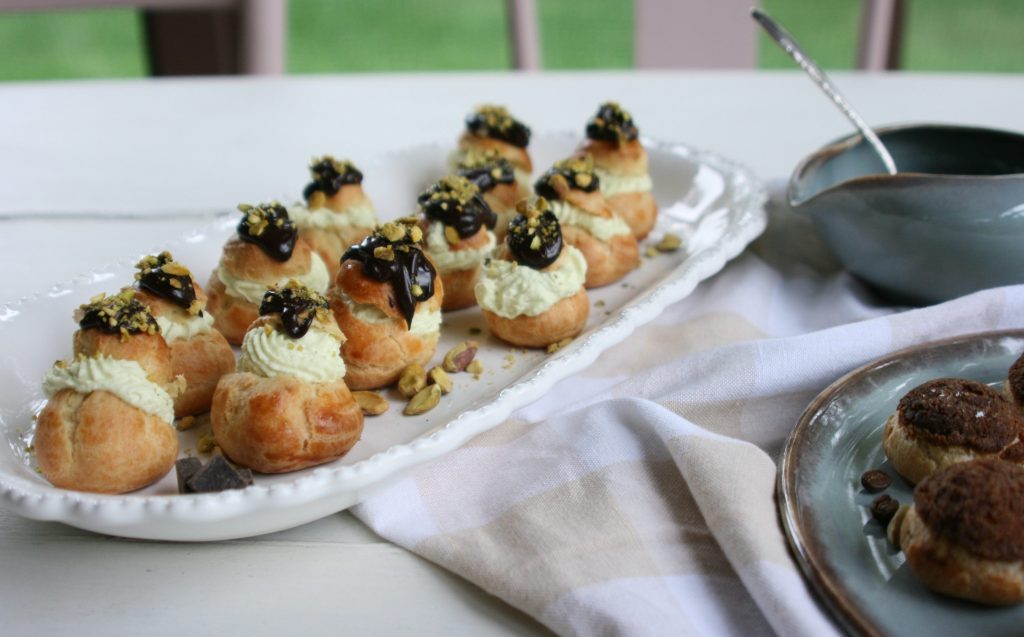
My pistachio cream filling is adapted from Spoonabilities.com, using a new product for me, pistachio cream, which I was able to get at my local Target store. I found this brand had fewer ingredients (only six!), with pistachios listed as the first ingredient, and no additives or artificial flavors. It was a lot easier to use than roasting, peeling and grinding pistachios myself!
For the coffee-cardamom pastry cream, I customized a basic pastry cream recipe with my homemade coffee extract, which I used here and in quite a few other bakes for this blog. Keep in mind this isn’t a simple alcohol-based coffee essence but a coffee concentrate mixed with caramelized sugar used by pastry chefs. Some common brands include Pastry1 and Trablit. I’ll be forever grateful to Susan Holding at the Little French Bakery for sharing her recipe on her website.
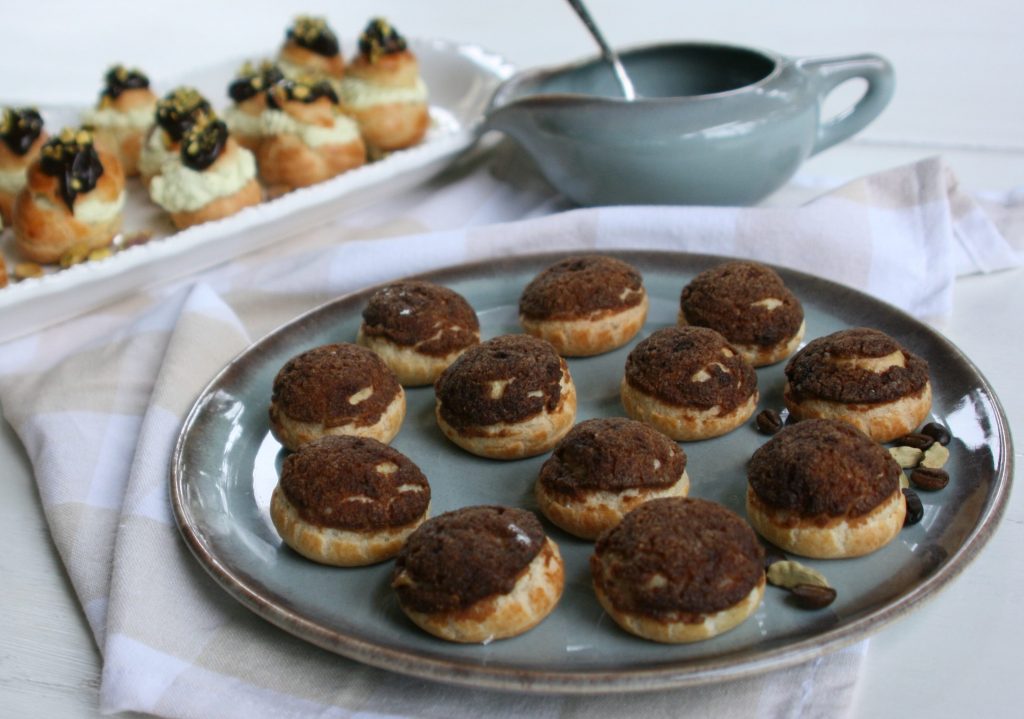
I was pleased with how my choux buns turned out. They were a bit smaller than I had hoped, nothing like the giant cream puffs the Wisconsin State Fair is famous for, but fairly uniform in size. At about two bites each, the coffee and cardamom pastry cream packs a flavorful punch in a small package. And the pistachio cream–filled choux buns were a treat for the eyes as well as the taste buds.
Once filled, choux buns are best eaten the same day or they will get soggy. Fortunately, choux batter will keep in the refrigerator for two or three days if kept in an airtight container or, better yet, a sealed pastry bag. Or you can bake the shells and store them in the freezer for up to two months, then thaw and crisp in a 350°F oven for 3-5 minutes before filling. Since I needed to fill mine for the photographs seen here, this gave me an excuse to take some to my daughter and visit with my six-month-old grandson for an hour or so. As any grandparent can attest, having them live close by is a real blessing!
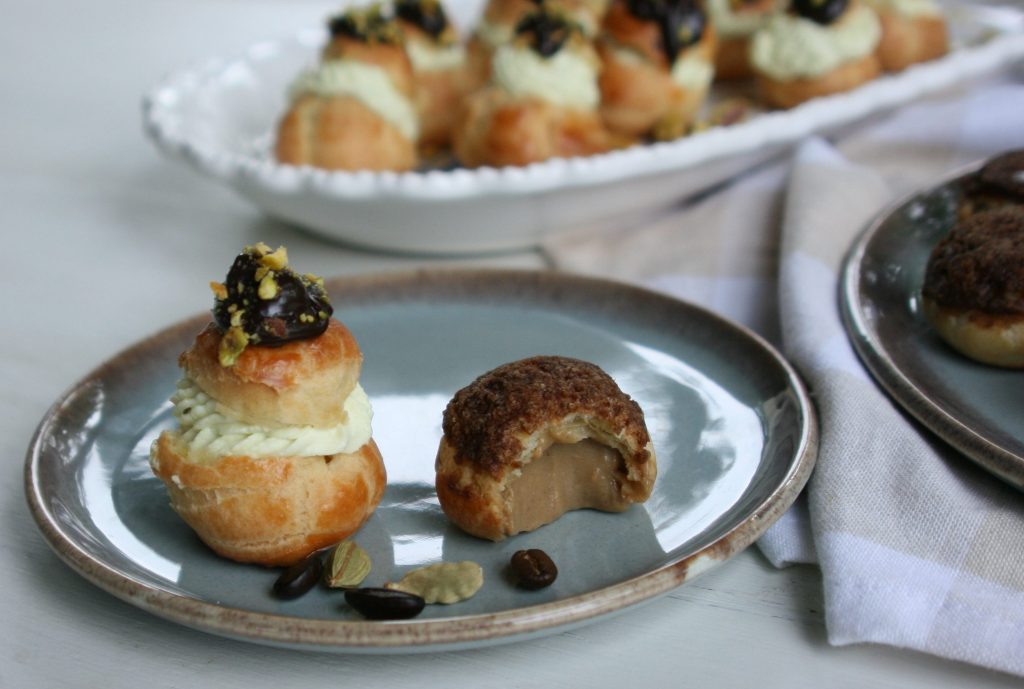
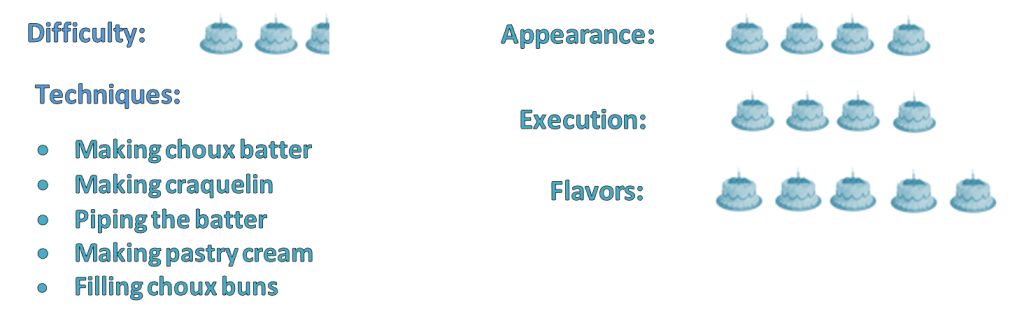
Coffee-Cardamom Craquelin Choux Buns and Pistachio-Mascarpone Choux Buns*
For the craquelin:
- ½ c. jaggery powder** (or 1/3 c. light brown sugar, packed)
- ½ c. all-purpose flour
- 4 T. salted butter, very soft
- ½ t. cardamom
For the choux pastry*:
- 1 c. all-purpose flour
- 4½ T. unsalted butter, diced
- ½ c. whole milk
- ½ t. salt
- ½ t. granulated sugar
- 1/3 c. water
- 4 eggs, beaten
- 1 egg yolk, beaten, for brushing
For the coffee and cardamom pastry cream:
- 2 c. half & half
- 1-2 T. coffee extract***, to taste
- 1 t. cardamom
- 9 T. granulated sugar, divided
- 1 large pinch of salt
- 3 T. cornstarch
- 5 egg yolks
- 4 T. butter, cubed
For the pistachio mascarpone cream:
- 8 oz. mascarpone cheese
- 1/3 c. pistachio cream
- 2 c. heavy whipping cream, divided
- 1/3 c. powdered sugar
For the chocolate ganache and assembly:
- 4 oz. semisweet chocolate, chopped
- ½ c. heavy cream
- ¼ c. chopped pistachios
Directions
- To make the craquelin, combine the sugar, flour, butter, and cardamom in a bowl, mixing well with a spoon, then bring the mixture together with your hands into a soft, slightly sticky ball of dough.
- Form the dough into a thick disk and place between 2 sheets of parchment paper. Roll out to 1/8 inch thickness, then transfer both paper and dough onto a baking sheet and place in the freezer while you make the choux pastry.
- To make the choux dough, first preheat the oven to 450°F. Sift the flour into a bowl and set aside.
- Put the butter, milk, salt, sugar, and water into a medium pan (preferably not a nonstick pan) and set over low heat until the butter has melted, then turn up the heat so the mixture comes to a boil (with just a few bubbles breaking through the surface).
- Quickly remove pan from the heat and dump all the sifted flour in at once. Rapidly beat the mixture with a spoon or silicone spatula until it forms a smooth, glossy dough. (This should take about 45-60 seconds of stirring.)
- Place the pan back on the burner over low heat and beat more gently for 1 to 2 minutes until the dough is very thick and forms a ball. Keep stirring until you see a film of dough form on the bottom of the pan. (NOTE: This will not occur with a nonstick pan.)
- Tip the ball of dough into the bowl of a stand mixer and let cool until it is barely warm (below 160°F). To speed this up, mix the dough gently for 2 to 3 minutes to release the steam, or flatten dough against the wall of the bowl and leave to cool for a few minutes.
- Add the eggs, a little at a time, beating well after each addition, until it forms a very smooth, glossy dough that holds its shape. (You can use a stand mixer or a spatula to mix in the eggs.) Stop adding eggs when the dough starts to look glossy, then check for the right consistency. (NOTE: The best way to tell when you have the right consistency is to lift the spoon/spatula from the bowl and see if the dough hanging from the spoon forms a V shape. The dough should also have a glossy sheen and a pipeable consistency.)
- Transfer the dough to a large piping bag fitted with a ½-inch plain nozzle and pipe 20 mounds, about 1½ inches in diameter each, onto baking sheets lined with parchment or a silicone mat, placing them at least an inch apart. (If using parchment, use a pencil to draw 1½-inch circles on the underside of the paper.) Lightly brush the top of each mound with the beaten egg yolk to flatten the peaks.
- Remove craquelin from the freezer, peel off the top sheet of paper and use a 1¼-inch round cutter to cut out 12 disks. Place a disk on top of each of 12 choux mounds.
- Transfer baking sheets to the oven, and immediately reduce the heat to 375°F. Bake for about 25-35 minutes, rotating the sheets after 20 minutes. Choux buns are done when they are puffed up, crisp and golden brown. Remove them from the oven and pierce each one with a skewer to allow steam to escape, then return them to the oven for 4-5 minutes to dry out. Remove from the oven and transfer to a wire rack to cool.
NOTE: Choux pastry shells can be made a day in advance and kept in an airtight container. To crisp them up again, place on a baking tray in 350°F oven for about 5 minutes. - To make the coffee-cardamom pastry cream, combine half & half, coffee extract, cardamom, and 2 tablespoons sugar in a stainless steel pan. Taste and adjust coffee and cardamom if desired.
- In a separate bowl, combine the rest of the sugar, salt, and cornstarch. Add the egg yolks and whisk until just combined.
- Over medium-low heat, bring the milk mixture to a boil. When the milk comes to a boil, pour 1/3 of it into the egg yolk mixture, stirring constantly to incorporate evenly and avoid cooking the eggs.
- Return egg mixture to the pan, stirring constantly. Continue to cook while stirring until it has boiled for about 2 minutes. Turn off the heat, add the butter and stir until butter has melted and is fully incorporated.
- If needed, pour mixture through a sieve to eliminate any lumps. Transfer the pastry cream to a clean, shallow pan and cover the surface with plastic wrap. Refrigerate until needed.
- To make the pistachio-mascarpone cream, mix the mascarpone, pistachio cream, and 1/2 cup heavy cream until well incorporated.
- In a separate bowl, whip the rest of the cream and powdered sugar together until soft peaks form. Add the mascarpone and pistachio mixture and whip until stiff peaks form. Refrigerate until ready to use.
- To make the ganache, place chocolate in a small, heat-proof bowl and set aside. In a small saucepan over medium heat, bring cream just to a boil. Remove from heat and immediately pour cream over the chocolate. Let it sit without stirring for 1-2 minutes, then whisk gently until chocolate is completely melted and mixture is smooth. Cool for 15-30 minutes until thickened but still pourable.
- To assemble the coffee and cardamom buns, uncover the pastry cream and hand-whisk so that it’s very smooth and light. (If it’s too stiff, warm it gently over a pot of simmering water while stirring constantly. If needed, add a little milk or cream, 1 tablespoon at a time, until it reaches pipeable consistency.) Transfer to a large piping bag fitted with a ¼-inch plain nozzle and pipe the filling into each choux bun through the steam hole.
- To assemble the pistachio choux buns, slice 1/3 of each choux bun off the top. Transfer pistachio cream to a piping bag fitted with a star tip. Pipe the cream into the bottom portion of each bun. Place top of each bun atop the cream. Pour a small amount of ganache over each and garnish with chopped pistachios.
*The choux pastry recipe can be halved if you only want to make one kind of choux bun.
**I happened to have some jaggery powder on hand, but you can just as easily use 60 grams of light muscovado sugar or 1/3 cup light brown sugar, packed.
***If you can’t find coffee extract in the store, make your own: Dissolve 1/4 lb. (scant 2 cups) instant coffee in 7 ounces of water in a small saucepan and bring to a boil. In another saucepan, add 1 cup of sugar and heat it until the sugar dissolves and turns a dark amber color. When the sugar is the right color, slowly pour in the hot coffee. (It will bubble and sputter, so be careful to protect your hands and fingers.) Stir until all of the caramel dissolves. Cool and store in the refrigerator.
Discover more from Here's the Dish
Subscribe to get the latest posts sent to your email.
